
Can't yet use high CNC supports? Come see what actually changes
This page is for engineers and buyers who keep hearing that a high-rigidity CNC support will fix their part, and want to know what it really does. We cover spindle and bearing choices, when a support helps, and when the problem is somewhere else in the process. By the end you should be able to judge whether your part needs it at all.
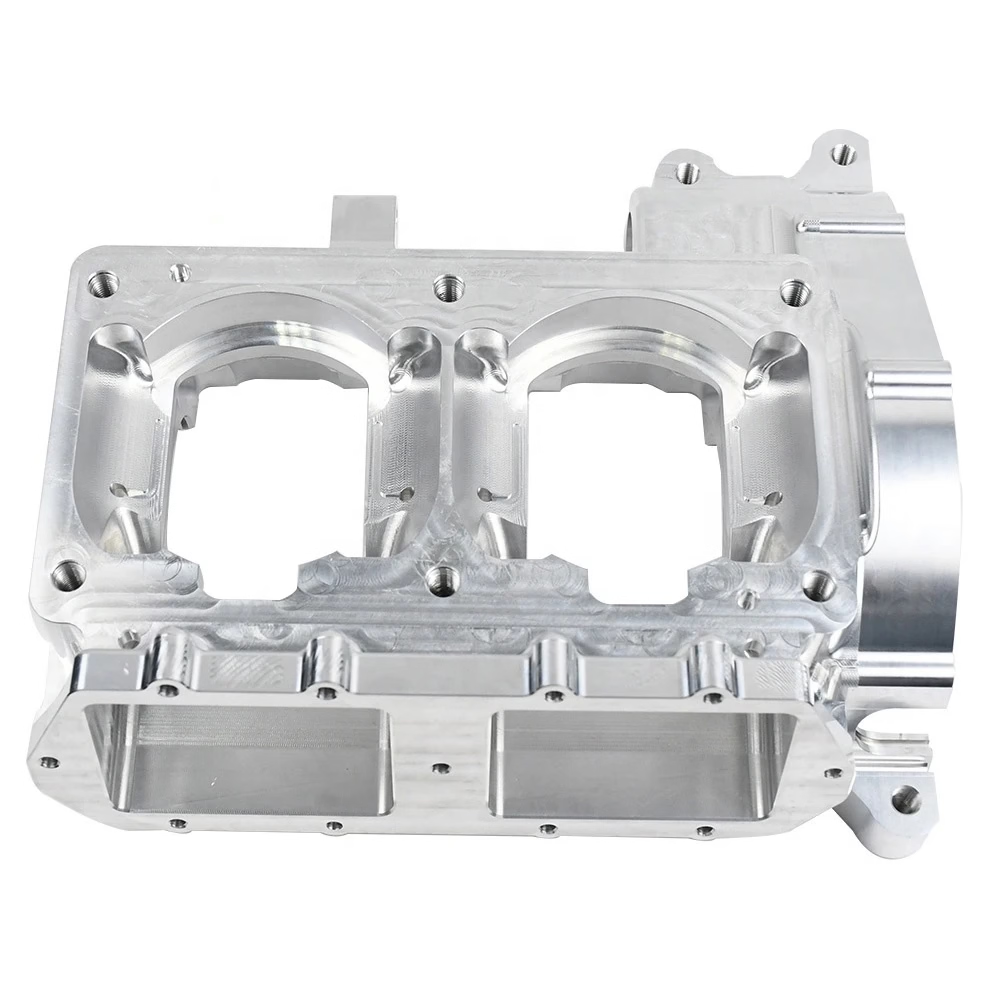
What a high-rigidity CNC support is, in plain terms
A support is not a bolt-on upgrade. It is a chain of stiffness decisions from the spindle down to the fixture.
Where the stiffness actually comes from
When engineers talk about a high CNC support, they usually mean one of three things: a spindle cartridge with large bearings, a rigid fixture that holds the part, or a machine frame stiff enough to resist chatter. Each one moves the result in a different way.
The support matters most when a tool pushes sideways. A long 20 mm end mill hanging 80 mm out of the holder will deflect under load, no matter how good the frame is. A short, large-diameter tool in a stiff holder cuts clean because the load path is short. That path runs from the cutting edge through the tool, the holder, the spindle, the column, and finally the base casting. Every joint adds compliance.
Bearings set the ceiling on speed and stability. High-precision angular contact bearings, preloaded and paired, hold the spindle axis in place at 12,000 rpm or more. Cheap bearings let the axis wander, and the wander shows up as a wavy surface on the part. That is why a support upgrade often starts at the spindle, not at the table.
Fixtures are the other half. A perfect spindle on a part that rings like a bell still cuts poorly. Dedicated soft jaws, vacuum plates, or a tombstone with proper clamping spread the load and damp vibration. For thin walls, a support inside the pocket can do more than any machine upgrade.
- 1Spindle supportLarge preloaded bearings, short tool overhang, high rpm capability.
- 2Fixture supportSoft jaws, vacuum plates, tombstones, internal pocket supports.
- 3Frame supportCast iron or polymer concrete base, linear guides, thermal stability.
- 4Tool supportShort gauge length, balanced holders, correct coating and geometry.
When a high-rigidity CNC support is worth it
The support pays off when the failure mode is deflection or chatter, not when it is setup error or tool wear. A part with a deep pocket, a long slender tool, or a thin floor is a candidate. So is any cut where the finish specification is tighter than Ra 1.6 μm and the tool has to reach far from the holder.
Parts that run on a 5-axis machine with a rotary table benefit too. The table itself is a support: a Ø400 mm rotary table with a stiff brake holds the part in place while the tool sweeps around it. Without that rigidity, the tool pushes the part instead of cutting it, and the error shows up on the far side of the rotation.
Material matters as well. Aluminum 6061 and 7075 cut easily but can chatter on thin ribs. Stainless 316 and 17-4PH work-harden, so a rigid setup lets you take a full depth of cut in one pass instead of rubbing. Titanium TC4 (Ti-6Al-4V) and Inconel generate high cutting forces, and a stiff support is close to mandatory.
A support is not always the fix. If the part is small and the tool is short, the machine already has enough stiffness. Extra support adds setup time and cost without changing the result. The honest answer is sometimes no.
- 1Worth itDeep pockets, long reach, thin walls, hard materials, tight finish.
- 2Not worth itShort tools, small parts, loose tolerances, simple 2.5D profiles.
- 3Try firstReduce tool overhang, change feed and speed, add a support inside the part.
Support type compared by what it fixes
Match the failure mode to the support, not the other way around.
| Support type | Best for | Limits |
|---|---|---|
| Spindle bearing upgrade | High rpm, fine finish, chatter at speed | Cost, rebuild downtime |
| Rigid fixture or tombstone | Thin walls, deep pockets, multi-part runs | Setup time, fixture cost |
| Rotary table with brake | 5-axis contouring, round features | Size limit, table travel |
| Internal pocket support | Thin floors, tall ribs, long reach | Extra programming, removal step |
| Short tool and holder | Any cut where reach allows | Geometry limits, tool availability |
| Machine frame and base | Heavy cuts, hard materials, thermal drift | Capital cost, floor space |
What we check before quoting a support-heavy part
We start with the geometry. A part with a 4:1 depth-to-width ratio in a pocket needs a different plan than a flat plate. The tool list follows: diameter, length, coating, and the number of passes. If the tool has to reach more than four times its diameter, we look at whether the pocket can be opened from the other side or roughed with a larger tool first.
Then we look at the material. Aluminum 6061-T6 and 6082 cut clean at 8,000 rpm with a 12 mm tool, and a rigid support keeps the finish at Ra 0.8–1.6 μm. Stainless 316 and 17-4PH need lower speeds and higher feed per tooth, and the support keeps the tool from rubbing. Titanium and Inconel run at 40–60 m/min, and any flex shows up as tool wear and a poor surface.
The fixture plan comes next. For a one-off prototype, soft jaws machined to the part profile are often enough. For a 10,000-part run, a dedicated tombstone or vacuum plate pays for itself. We also check whether the part can be supported from inside, which is common on housings and manifolds.
Finally we check the machine. A part that fits in a 500 × 500 × 450 mm envelope can run on a compact 3-axis machine with a stiff spindle. A 4,000 mm part needs the large travel machine, and the support question becomes about the bed and the number of setups. Fewer setups means less error stacking.
- 1Geometry checkDepth-to-width ratio, wall thickness, tool reach.
- 2Material checkCutting speed, feed per tooth, work-hardening risk.
- 3Fixture checkSoft jaws, tombstones, vacuum, internal supports.
- 4Machine checkTravel envelope, spindle stiffness, setup count.
Common questions from engineers
Can I use a high-rigidity CNC support on a small part?
Yes, but it may not change the result. On a part under 100 mm with a short tool, the machine spindle is usually stiff enough. The support adds setup time without improving the cut.
The exception is a small part with a deep, narrow slot or a thin floor. There the support inside the pocket does matter, even at small scale.
Does a rigid support replace the need for a finishing pass?
No. A rigid setup lets you take a heavier roughing cut and leave less stock, but the finishing pass still sets the surface finish and the final dimension.
With a good support we can hold ±0.005 mm and Ra 0.8–1.6 μm on a finishing pass. Without it, the same pass may leave chatter marks.
What tolerance can you hold on a support-heavy part?
We hold ±0.005 mm (±0.0002 in) on features that are reachable with a short, rigid tool. On long-reach features, the tolerance depends on the tool length and the material.
We inspect 100% of parts before shipment and can supply inspection reports on request.
How does the support affect lead time?
A standard part quotes in 12 hours with a free DFM analysis. Production can start within 24 hours, and parts ship in 3–5 days.
A support-heavy part with a custom fixture may add a day for fixture setup. We flag that in the quote, not after.
Can you support thin walls and deep pockets?
Yes. We use internal pocket supports, soft jaws, and light finishing passes. For thin walls we often machine both sides in separate setups to control stress.
Materials like aluminum 6061 and 7075 respond well. Stainless 316 needs more care because it work-hardens.
Do you need an NDA for a support-heavy part?
No, but we can sign one. Uploads are secure and confidential, and an NDA is available on request.
If your part has a patent-pending geometry or a customer-specific interface, send the NDA with the files.
Send your part and we will tell you if the support matters
Upload a STEP file and we will quote in 12 hours with a free DFM analysis. If your part does not need a high-rigidity setup, we will say so.
12-hour quote100% inspectionNDA on request









