
Belotti CNC machining excellence, judged by the part
This page explains what Belotti CNC machining excellence means on the shop floor, where its 5-axis strengths actually show up, and when a simpler machine is the better call. Written for engineers and buyers comparing quotes on complex parts. By the end you should know which features drive cost and which machine class fits your geometry.
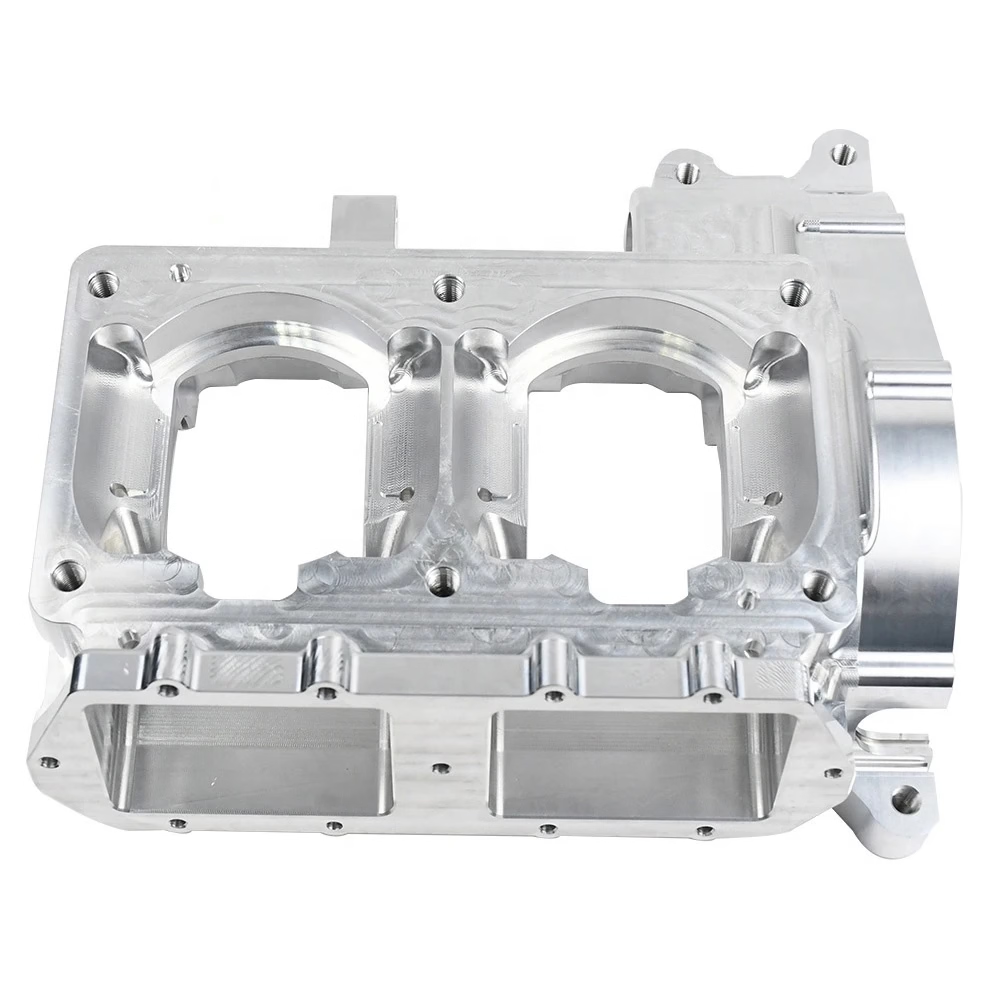
What this guide covers
Machine choice, setup count, tolerance, and material behavior on 5-axis work.
What Belotti CNC machining excellence means on the floor
Belotti builds high-speed 5-axis machining centers, mostly gantry and bridge styles, used for molds, aerospace structural parts, and large automotive tooling. The word excellence gets attached to the brand a lot. In a job shop, the useful definition is narrower: can the machine reach the feature, hold the tolerance, and finish the surface in one setup instead of four?
That question decides cost more than spindle speed does. A part that needs five separate 3-axis setups carries five chances of stack-up error, five fixturing cycles, and five trips through the quality room. A simultaneous 5-axis machine that reaches the same surfaces in one setup removes most of that overhead. When the geometry is angled, deep, or interrupted, that difference is the whole quote.
GreatLight runs 127 high-precision CNC machines across three plants in Dongguan and one in Singapore, including 16 simultaneous 5-axis machining centers, 12 four-axis mills, and 16 mill-turn centers. A Belotti-class 5-axis job sits on those centers. What follows is how we decide whether a part belongs there, and what you should check before you send it out.
- 1One setup beats fiveFewer re-clamps means less stack-up error and shorter lead time.
- 2Reach mattersAngled faces and deep pockets need spindle clearance, not just axis count.
- 3Not every part needs 5 axesFlat plates with one drilled face run faster on a 3-axis mill.
Which parts actually belong on a 5-axis center
Start with the number of faces that carry a tolerance. If a part has three or more machined faces that must line up with each other, 5-axis work is usually cheaper overall even at a higher hourly rate, because the alternative is multiple fixtures and multiple datums. If only one face matters, a 3-axis machine will beat it on price every time.
The second test is tool access. Angled holes, undercut walls, deep ribs, and swept surfaces that a short tool cannot reach from a single direction are natural 5-axis work. A Ø6 mm end mill sticking out 60 mm will chatter no matter how good the machine is. Tilting the part lets you use a shorter, stiffer tool, and that changes surface finish and tool life at the same time.
The third test is volume. For one prototype, the setup time on a 5-axis machine may not pay back. For a run of 500 parts with a recurring angled feature, a 5-axis program with soft jaws or a custom fixture usually wins, because the per-part cycle drops once setup is amortized. That crossover point is worth calculating before you assume 5-axis is expensive.
Holding tolerance and finish on angled surfaces
Positional tolerance on a 5-axis part is not one number. The rotary axes introduce their own error, and the error grows with the distance from the rotary center. Features near the center of a trunnion hold tighter than features 800 mm out on a bridge machine. When we quote ±0.005 mm, that applies to a defined set of features, and we say which ones on the inspection report.
Surface finish follows the same logic. A tilted cut changes the effective contact between tool and workpiece, so the same feed and speed that gives Ra 0.8–1.6 μm on a flat face can leave a different texture on a 45° wall. If your drawing calls out Ra 0.2–0.8 μm on a curved surface, expect a finishing pass with a smaller stepover and a longer cycle.
We inspect 100% of parts before shipment, with raw material checks, in-process monitoring, and a final report. Inspection reports are available on request. For first articles on a new 5-axis program, we normally run a full dimensional report before releasing the rest of the batch, because that is cheaper than discovering a rotary offset error on part 300.
- 1Rotary error grows with radiusTight features belong near the rotary center.
- 2Finish depends on tool angleSpecify finish by feature, not for the whole part.
- 3First article before the batchOne full report prevents a scrapped run.
Machine class by part geometry
Use this to sanity-check the machine your quote is built on.
| Part geometry | Suggested machine | Why |
|---|---|---|
| One flat face, simple holes | 3-axis mill | Lowest setup cost, fastest cycle |
| Four sides, no compound angles | 4-axis mill | Rotary index cuts re-fixturing in half |
| Angled holes and undercuts | 5-axis simultaneous | Shorter tools, one datum, fewer setups |
| Swept or organic surfaces | 5-axis simultaneous | Continuous tool vector keeps stepover even |
| Turned body with milled flats | Mill-turn center | One chucking, better concentricity |
| Part longer than 1,000 mm | Bridge-style 5-axis | Travel up to 4,000 × 400 × 150 mm |
Materials that behave well on a 5-axis spindle
Aluminium is the easy case. 6061, 7075, and 6082 all cut cleanly at high spindle speeds, and a tilted cut on 7075 helps clear chips from deep pockets instead of recutting them. Thin-wall aluminium parts benefit most from 5-axis work, because you can reach both sides without clamping the wall and springing it.
Stainless and titanium are the opposite. 316L and 17-4PH work-harden if the tool rubs, so the rigidity of a 5-axis setup is an advantage, but the cut has to stay in the material. TC4 (Ti-6Al-4V) and Inconel generate heat at the cutting edge, and that heat goes into the tool. We run these slower, with more coolant, and accept a longer cycle.
Plastics and composites are a fit for the same reason as aluminium: reach. PEEK and carbon fibre parts often have shaped surfaces and thin sections that are hard to hold. Cutting them with the part tilted lets you keep the tool engaged and avoid delamination at the exit edge. If your part is a flat plate with a pattern of holes, none of this applies, and a 3-axis machine is the right answer.
What to send with a 5-axis quote request
A STEP file alone gets you a rough number. What gets you a useful one is a drawing or a model with a defined datum scheme, the features that carry tolerance, and the surfaces that carry a finish callout. If the datum is not defined, we pick one that makes sense for machining, and that choice may not match your inspection setup.
Tell us the quantity and whether the part is a prototype or a repeat. There is no minimum order quantity here, from one prototype to runs over 10,000 parts, and the right process changes with volume. A prototype might be machined from billet; a 10,000-part run might start as a die casting and get finish-machined on a 5-axis center.
Uploads are handled as confidential, and we can sign an NDA before files move. For quoting, we return a price and a free DFM analysis within 12 hours, and production can start within 24 hours of approval. Parts ship in 3–5 days for standard work. If a feature is going to drive cost, we say so in the DFM notes rather than burying it in the price.
- 1Define the datumMachining datums and inspection datums should match.
- 2Mark the tight featuresList which dimensions need ±0.005 mm.
- 3State the quantityProcess choice changes between 1 and 10,000 parts.
Common questions
Is a Belotti machine required to get this level of accuracy?
No. The brand is not the guarantee. What matters is a rigid 5-axis platform, a calibrated rotary, and a process that proves the setup before the batch runs.
We machine on 16 simultaneous 5-axis centers with a Ø400 mm rotary table and bridge machines with travel up to 4,000 × 400 × 150 mm, and we report which machine ran your part.
Can you hold ±0.005 mm on a large 5-axis part?
On defined features, yes, and we list them on the inspection report. Accuracy drops as you move away from the rotary center, so a feature 800 mm out is not the same job as one near the table.
If a critical dimension sits far from the rotary axis, we will say so during DFM and suggest a datum or setup change.
Which materials do you run on 5-axis centers?
Aluminium grades including 6061, 7075, 6082, and ADC12; stainless including 303, 316L, 17-4PH, and 440C; steel including 4140 and 4340; titanium TA2 and TC4; plus copper alloys, PEEK, POM, and carbon fibre.
Titanium and Inconel run with longer cycles because the heat stays in the cut.
How do you handle confidentiality on a new part?
Uploads are secure and confidential, and we can execute an NDA before you send files.
Models, drawings, and inspection data stay with the project team.
What lead time should I plan for?
Quotation and free DFM analysis come back within 12 hours. Production can start within 24 hours of approval, and standard parts ship in 3–5 days.
Historical late-delivery probability is below 2%. Complex first articles with a full dimensional report take longer, and we will tell you the number up front.
Send the part that is hard to hold
Upload a STEP file with your tolerance and finish callouts. You get a price, a DFM analysis, and a machine recommendation within 12 hours.
12-hour quote100% inspectionNDA on requestNo minimum order quantity









