
Basic Knowledge CNC Tower: Turrets, Tool Changers and Tool Holding
In shop talk, a CNC tower usually means the tool turret on a lathe or the tool magazine on a mill. This page explains what sits inside those systems, how many tools they hold, how they repeat, and when a turret or ATC is the wrong choice for a part. Written for engineers and buyers who spec machined parts.
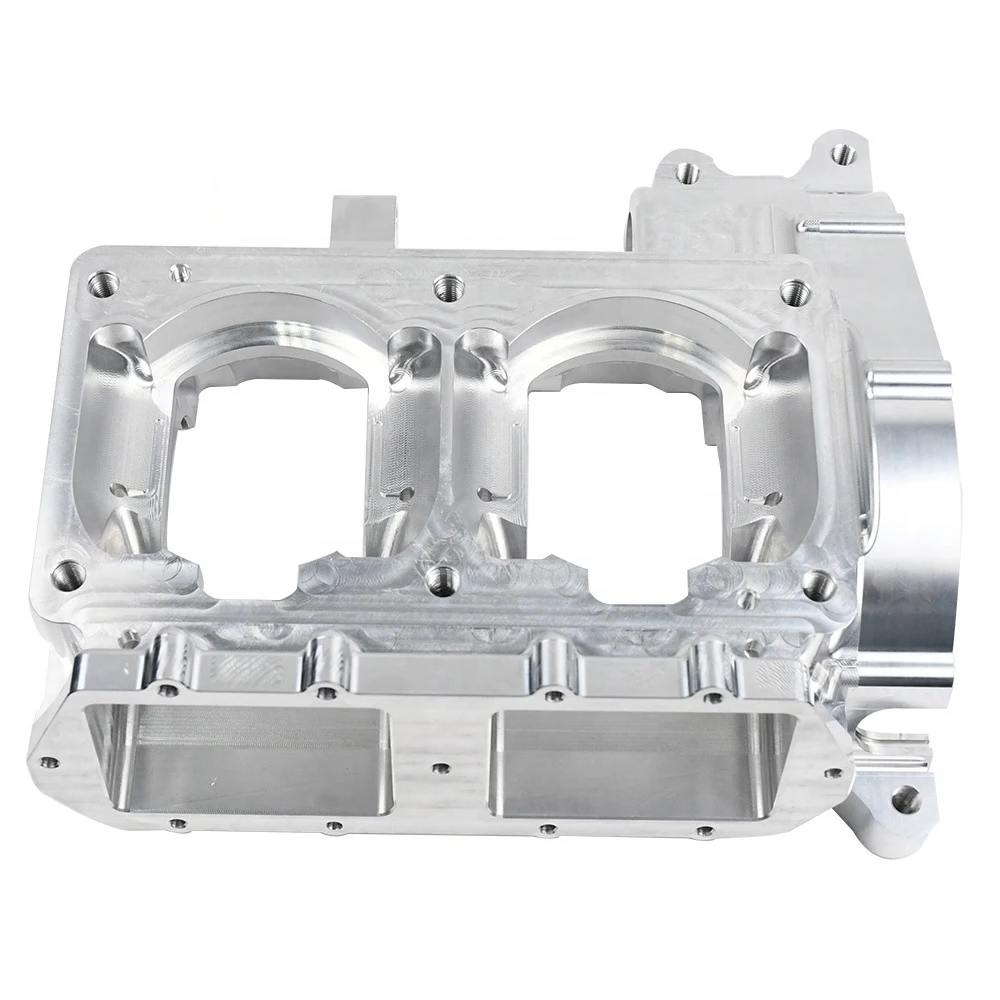
What the term covers on the shop floor
Tool holding is the part of a machine that decides whether a good program becomes a good part.
A CNC tower is a tool holding system, not the machine itself
On a lathe, the tower is the turret: a rotating block that indexes cutting tools into position. On a machining center it is the tool magazine, often a drum or chain, feeding tools to the spindle through an automatic tool changer. Both carry the same job. They store tools, move them into the cut, and return them without an operator touching the machine.
This is the first piece of basic knowledge worth nailing down: the tower does not cut metal. The spindle and the tool do. A poorly maintained turret still produces bad parts even when the spindle and program are perfect. Index repeatability, taper contact and clamp force are what hold your size tolerance over a 10,000 part run.
People new to machining often expect the tower to be the whole machine. It is closer to the tool rack than the engine. Understand that split and the rest of the system, offsets, tool life, chip clearance, starts to make sense.
Turret types: disc, gang and live tooling
A disc turret holds 8 to 12 tools on a rotating face. Index time is short, and each station can carry a boring bar, a turning holder or a drill. A drum turret holds more tools but swings a larger mass, which shows up on small lathes as slower indexing. Gang tooling skips the turret entirely and mounts tools on a plate; it is fast and rigid, but travel is limited and tool count is low.
Live tooling adds a driven motor to selected stations. That lets a lathe mill flats, drill cross holes and cut slots without a second setup. For parts with a turned body plus a few side features, a live-tool lathe often beats a mill-and-turn route on both cycle time and positional accuracy.
Where a turret struggles: deep bores that need long, slender bars, and heavy interrupted cuts that want maximum rigidity at the spindle nose. Those jobs do better on a mill or a dedicated boring setup.
- 1Disc turret8–12 tools, fast index, good for small and medium turned parts.
- 2Drum turretHigher tool count, more mass, slower on compact lathes.
- 3Gang toolingVery rigid and quick, but low tool count and short travel.
- 4Live toolingAdds milling and cross drilling to a turning setup.
How an automatic tool changer actually repeats
An ATC swaps the tool in the spindle for one in the magazine. The chain of events is mechanical: the spindle stops and orients, the drawbar releases, the arm grips the tool, pulls it from the taper, rotates, pushes the next tool in, and the drawbar clamps. Each step has a tolerance. Errors stack, and the part feels them as position shift between tools.
Two numbers matter. Tool-to-tool repeatability is how close a tool returns to the same spindle position after each change. Machine positioning accuracy is how close the axis gets to commanded coordinates. If both sit inside a few micrometres, a 10-tool program holds size across all operations. If the taper is dirty or the pull stud is worn, both numbers drift and the operator starts chasing offsets.
Tool change time is often quoted in seconds, but the real cost is the cut-to-cut time: rapid to the change point, orient, swap, rapid back. On a part with 20 tools and 40 changes, a slow ATC can add minutes per piece. For high-volume work, magazine layout matters as much as raw spindle speed.
Turret and ATC types at a glance
Use this to judge which tool holding system fits a part before quoting.
| System | Typical tool count | Best for | Main limit |
|---|---|---|---|
| Disc turret | 8–12 | Small and medium turned parts | Limited boring bar length |
| Drum turret | 12–24 | Parts needing many turning tools | Slower index on small lathes |
| Gang tooling | 4–8 | Short cycle, high volume turning | Very short Z travel |
| Live tool turret | 6–12 driven | Turned parts with side features | Lower milling rigidity |
| Drum ATC | 20–30 | General milling, mixed tooling | Magazine size and swap time |
| Chain ATC | 40–120 | Complex parts, long tool lists | Floor space and cost |
Taper, holders and pull studs decide the real accuracy
Most machining centers use a 7/24 taper: BT30, BT40, BT50, CAT or HSK. The taper centers the tool; the pull stud pulls it into contact and holds it there. Contact area is everything. A chip or a smear of dried coolant on the taper cuts contact, and the tool deflects under load. That shows up as chatter, poor finish and size drift, not as an obvious crash.
HSK and similar hollow tapers add face contact, which improves stiffness at high spindle speeds. For finishing at Ra 0.2–0.8 μm on aluminium or thin-wall parts, that extra stiffness is often the difference between a clean cut and a scrapped part. For roughing steel at moderate speed, a good BT40 holder with balanced runout is usually enough.
Holder runout, not the machine, sets the floor on hole size and finish. A holder with 0.02 mm runout will cut an oversized hole no matter how well the machine is aligned. We check runout on critical holders and replace pull studs on a schedule. That is routine maintenance, and it is cheaper than reworking parts.
- 1Keep tapers cleanWipe every taper before loading; a chip shifts the cut.
- 2Check pull studsWorn studs reduce clamp force and cause pull-out.
- 3Measure holder runoutRunout sets the floor on hole size and finish.
- 4Match holder to jobFace contact for high speed, solid taper for roughing.
When a turret or ATC is the wrong answer
Tool holding systems pay off when a part needs many tools and repeat setups. A one-off bracket with three holes does not benefit from a 60-tool chain. Setup time dominates, and a simple three-axis machine with a few holders gets there faster and cheaper.
Very large parts are another case. Our largest travel is 4,000 × 400 × 150 mm, and on that class of work the tool is often set manually or held in a small magazine. A big ATC would add cost without helping the cut. Same logic for parts that need one form tool and a long cycle: the tower sits idle while the tool wears.
The useful rule is simple. Count the distinct tools and the number of changes per part. If the count is high and the run is long, a turret or ATC earns its place. If tools are few and the run is short, spend the money on fixturing and inspection instead.
Common questions
How many tools does a CNC turret hold?
Disc turrets typically hold 8 to 12 tools. Drum turrets can hold 12 to 24, depending on the lathe size.
Live tooling stations carry driven holders, so a 12-station turret may offer 6 to 12 driven positions for milling and cross drilling.
What tolerance can a turret or ATC hold?
Tool holding is one link in the chain. With clean tapers, good holders and a maintained machine, we hold ±0.005 mm (±0.0002 in) on turned and milled features.
If the part needs tighter than that, it usually needs a different process route, not a different turret.
Does a turret add cost to a quote?
It can reduce cost when a part needs many tools or a long run, because fewer setups means less handling and better repeatability.
For simple parts with two or three tools, a plain turning or milling setup is often cheaper. We pick the route that fits the part.
Can a live tool turret replace a mill?
For side holes, flats and slots on a turned part, often yes, and it saves a second setup.
For deep pockets or heavy milling, no. A dedicated mill has more rigidity and travel. We split the work when the geometry demands it.
How do you keep tool offsets stable over a long run?
We check the first article, monitor size in process, and replace worn tools on a schedule rather than waiting for a bad part.
Every part gets a final inspection before shipment, and reports are available on request.
Do you support small orders with turret work?
Yes. There is no minimum order quantity, from one prototype to 10,000+ part runs.
Uploads stay secure and confidential, and an NDA is available on request.
Send a drawing and we will pick the right tool holding route
We review geometry, tool count and run size, then quote the setup that holds your tolerance at the lowest total cost.
12-hour quote100% inspectionNo minimum order quantityNDA available









