
Basic knowledge of cnc wooden beds
What actually happens inside a CNC machine when it cuts a wooden bed frame, and where the process stops making sense. Written for engineers and buyers who need to judge a quote, a drawing, or a supplier claim without guesswork.
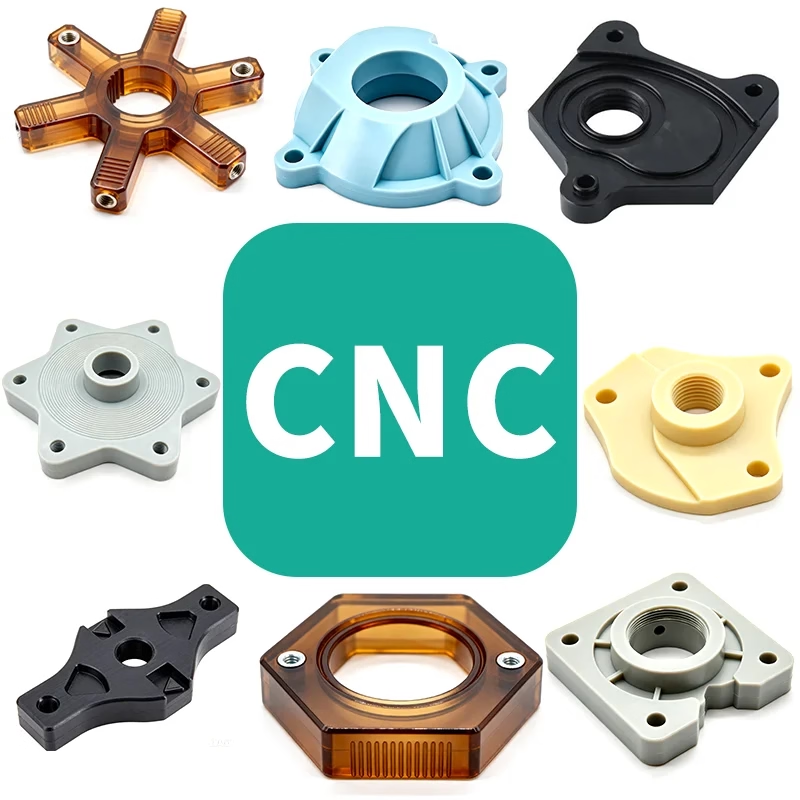
How a CNC machine removes wood
A CNC wooden bed is not a single object. It is a frame, a set of slats or panels, and usually a group of metal inserts and brackets that hold everything together. The machine does not care what the part is called. It moves a spinning cutter along a path taken from a CAD model, and that path is identical on part one and part five thousand.
Two motions matter. The tool rotates at spindle speed, and the table or gantry carries the work past it at feed rate. Chip load per tooth is the number that decides whether the cut is clean or scorched. Too low and the edge rubs, glazing the surface. Too high and the tool grabs grain and tears it out.
Wood is not a homogeneous material. Earlywood and latewood have different density, and a cutter crossing both at the same feed rate will deflect differently in each. That is why a hardwood frame may need two passes where a softwood frame needs one.
Chip evacuation is the other half of the job. Wood dust packs into a deep pocket and recuts, which burns the wall and dulls the tool fast. Downcut or compression cutters push chips up and out, and they cost more for a reason.
- 1Spindle speedHigher rpm suits small-diameter tools; large cutters need torque, not speed.
- 2Feed rateSet from chip load, not from how the cut sounds.
- 3Depth of cutKeep it under half the cutter diameter in hardwood to limit deflection.
Frame, rails and workholding on cnc wooden beds
On a lathe-style machine the workpiece turns and the tool follows a programmed path. On a router-style machine the workpiece is clamped and the spindle travels. Bed frames are almost always the second type, because a rectangular frame will not spin.
Rails and bearings set the floor for accuracy. A rail with play shows up as chatter on long slats and as a stepped surface on curved headboards. Machine builders grind and lap these components to micron-level straightness before assembly, and that work is invisible once the machine is running.
Workholding decides whether the fixture or the part absorbs the cutting force. Vacuum tables suit flat panels. Mechanical clamps and pod-and-rail fixtures suit frames with openings. On thin slats, a light climb cut with a downcut tool keeps the part from lifting off the table.
Thermal drift is real on long runs. A machine that holds ±0.05 mm in the morning can drift past that by afternoon if the shop temperature swings. For wooden parts this rarely matters. For the metal inserts pressed into the same frame, it does.
- 1Vacuum tableFlat panels and sheets; needs a smooth, sealed face to hold.
- 2Pod and railFrames and shaped parts; leaves the machined face free.
- 3Mechanical clampsHeavy or irregular blanks where vacuum cannot seal.
Tool selection and the tolerances wood can hold
Carbide tooling dominates production wood cutting. It holds an edge through abrasive species and through the glue lines in engineered panels. High-speed steel still has a place in short runs and in tight-radius profile work where a custom grind is cheaper than a custom carbide form.
Geometry matters more than coating. A compression cutter has upcut flutes at the tip and downcut flutes above, so it pulls the top and bottom edges inward at the same time. That is the standard answer to tearout on veneered panels.
Tolerance is where expectations need resetting. Wood moves with humidity, so a wooden feature cannot hold ±0.005 mm over a day, let alone a season. Metal inserts, dowel pins and threaded bosses machined into the same assembly can hold that figure, and that is usually where the drawing tolerance belongs.
Surface finish follows the same logic. A sanded hardwood face reaches a visual finish, not a measured Ra value. If a spec sheet quotes Ra on a wood surface, ask which direction it was measured and at what moisture content.
- 1Compression cutterVeneered and laminated panels where both faces must stay clean.
- 2Downcut spiralThin slats and fragile top edges.
- 3Upcut spiralDeep pockets where chip removal beats edge quality.
- 4Diamond or PCDLong runs in abrasive board; high cost, long life.
When machining wood is the wrong answer
CNC wood cutting pays off when the same profile repeats, when the part carries metal hardware, or when the geometry cannot be produced by hand at the required consistency. A one-off decorative carving is often cheaper from a skilled hand than from a programmed machine.
Moisture content is the hard limit. Kiln-dried stock at 6 to 8 percent behaves predictably. Green or poorly dried stock moves after machining, and a joint that fit on the bench will open in a dry room. No machine setting fixes that.
Dust is a safety and a maintenance issue, not a nuisance. Fine wood dust is combustible, and it also finds its way into linear guides and spindle bearings. Extraction at the cutter, not at the floor, is what keeps both risks down.
Cost is not the deciding factor on its own. If a part needs a ±0.05 mm metal interface, a bolted joint pattern, or a documented inspection record, the machining route is the only one that produces a traceable result. If none of those apply, a simpler process probably wins.
- 1Good fitRepeated profiles, metal inserts, tight hole patterns, hybrid frames.
- 2Poor fitSingle decorative pieces, unstable stock, parts with no repeat quantity.
Matching the process to the part
Use this to pick a route before the quote stage.
| Part feature | CNC wood routing | Hand or bench work | Hybrid: wood + machined metal |
|---|---|---|---|
| Repeated frame profile | Consistent across the run | Varies with the operator | Best overall match |
| Curved headboard | Programmed once, cut many times | Slow and hard to repeat | Metal brackets set the curve |
| Dowel and bolt holes | Position held by the program | Layout marks drift | Metal inserts hold ±0.005 mm |
| One-off carving | Programming cost may not pay back | Faster for a single piece | Rarely justified |
| Unstable or green stock | Moves after machining | Moves after machining | Same problem in both routes |
| Veneered panel edges | Compression cutter limits tearout | Hand trimming risks the veneer | Trim cut after insert fitting |
| Inspection record needed | Measured and reported | Not usually documented | Report covers metal features |
Which route to take
If the wooden parts repeat and the frame carries metal inserts or a bolt pattern, machine the whole assembly and hold the tight tolerances on the metal. If it is a single decorative piece in stable stock, hand work is faster and cheaper.
Questions that come up before quoting
What tolerance can a machined wooden bed frame actually hold?
On the wood itself, expect a working range of about ±0.2 mm on a stable, kiln-dried hardwood, and looser on softwood or on long unsupported spans.
Metal inserts, dowel pins and threaded bosses machined into the same frame can hold ±0.005 mm. Put the tight callouts on those features, not on the timber.
Why does a drawing call out a wood finish in Ra?
It usually should not. Wood has no stable Ra value in the way steel does, because the reading changes with grain direction, moisture content and species.
A better spec is a visual standard plus a sanding grit, with Ra reserved for metal contact faces in the same assembly.
Does moisture content change the machining plan?
Yes. Stock at 6 to 8 percent moisture content cuts cleanly and stays stable after machining. Anything wetter will shrink after the cut.
If the parts ship to a dry climate, machine from stock acclimated to that end condition, not to the shop floor.
Can one shop cut the wood and machine the metal hardware?
It is the better arrangement when the two must fit. Cutting wood in one place and metal in another leaves the interface to luck and to rework.
GreatLight machines the metal side of these assemblies on 3-axis, 4-axis and 5-axis centers, with the wood features programmed to match.
What drives the cost of a machined wooden frame?
Programming and fixturing are fixed costs, so quantity per setup matters more than part size. Tool life in abrasive species is the next factor.
Extraction and dust handling add shop time that a hand process does not carry. That cost is real and should be in the quote.
Is CNC wood cutting compatible with tight lead times?
It can be, if the drawing is settled. Programming and a first-article check take the most calendar time, not the cutting.
Once the setup is proven, extra parts come off at the cycle time, which is why a repeat run is far cheaper per piece than a first run.
Send the drawing, get a real answer
We review the wood features and the metal inserts together, flag what will not hold, and quote the parts that will.
12-hour quoteFree DFM analysisNo minimum order100% inspection
More from GreatLight
We publish setup notes, tooling trials and inspection data from the factory floor.











