
Babyliss Pro Nano Titanium vs. Cheap Dryers: Where CNC Machining Decides the Outcome
A part-by-part look at how a Babyliss Pro Nano Titanium dryer is built, and what a low-cost dryer skips to hit its price. Written for product engineers, tooling buyers and anyone sourcing hair-tool components. After reading, you should be able to judge which internal features actually drive heat stability, airflow and service life.
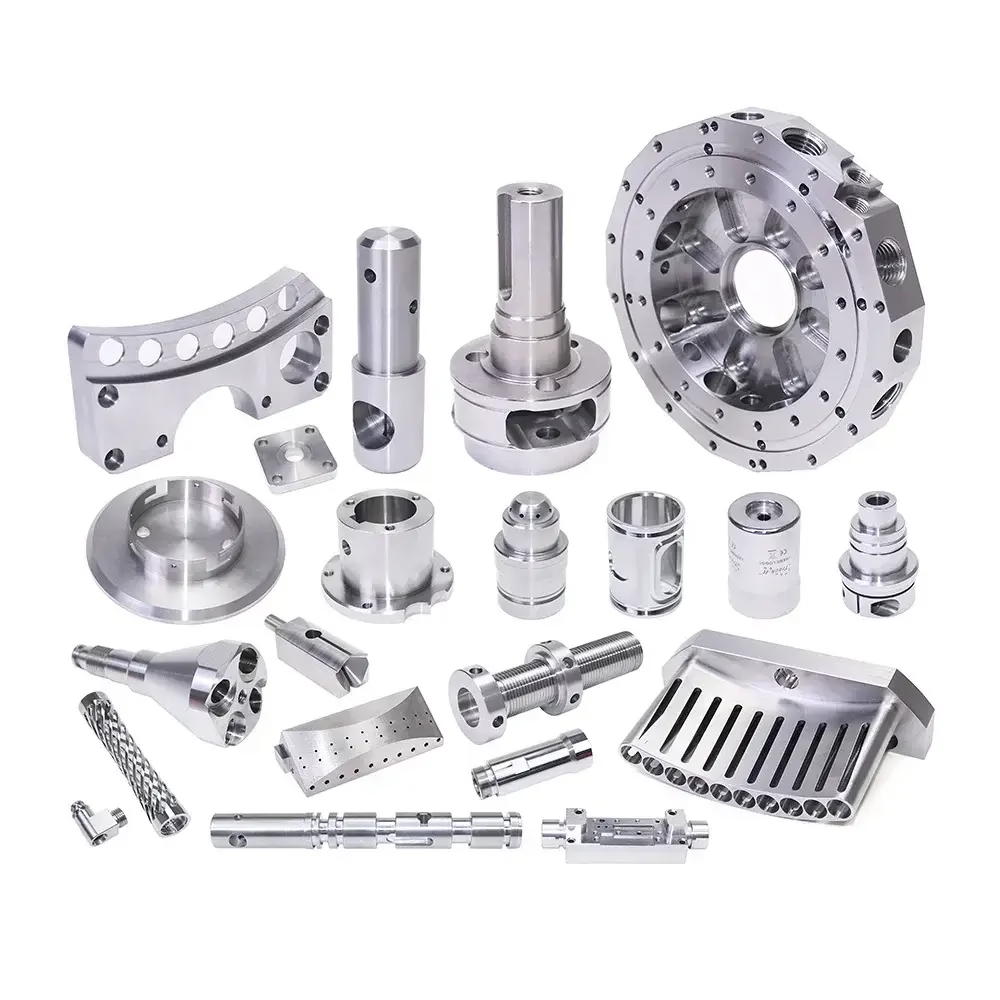
What Actually Separates the Two Price Tiers
Two dryers can look identical on a shelf. The difference sits inside the housing, in wall thickness, bore concentricity and how the heater block meets its mount.
Where Tight Tolerances Change the Air Path
The nozzle exit on a Babyliss Pro Nano Titanium dryer is a machined bore, held to a concentricity the molded plastic parts on cheap units cannot match. That matters because the fan pushes roughly the same volume of air either way. What changes is where the air goes. A bore that runs 0.05 mm off center tilts the flow, so one side of the nozzle runs hotter than the other.
Wall thickness on the housing is the second variable. Machined aluminum or titanium sections hold a uniform wall, which keeps the thermal path predictable. Stamped steel and injection-molded shells vary by a few tenths of a millimeter, and those variations show up as hot spots on the barrel after ten minutes of use.
The heater mount is the third. Three screws into a machined boss locate the element repeatably. On a stamped bracket, the element can shift under vibration, and the gap between coil and housing changes with it. That gap is the difference between a stable 60 °C surface and one that climbs past 80 °C.
- 1Bore concentricityKeeps airflow centered; ±0.005 mm on the nozzle seat is routine for us.
- 2Uniform wallPredictable thermal path instead of local hot spots.
- 3Repeatable mountHeater element stays where it was designed to sit.
Machined Components vs. Stamped and Molded Parts
A quick reference for the parts that differ most between the two tiers.
| Component | Machined version | Stamped / molded version |
|---|---|---|
| Nozzle bore | Concentric within ±0.005 mm | Off-center by 0.05 mm or more |
| Heater mount | Machined boss, three-point location | Stamped bracket, shifts under vibration |
| Housing wall | Uniform thickness, Ra 0.8–1.6 μm | Varies with mold or die wear |
| Fan hub | Balanced at 20,000 rpm and above | Rough balance, vibration at speed |
| Barrel surface | Anodized or bead blasted, even finish | Paint over uneven substrate |
| Threaded joints | Cut threads, no burrs | Rolled or formed, loose fit |
Why Titanium and Aluminum Are Used Together
Titanium earns its place in the barrel and heater housing. It conducts heat slowly compared to aluminum, so the outer surface stays cooler while the air inside reaches temperature. Grade TC4 (Ti-6Al-4V) holds its shape through thousands of heat cycles. Grade TA2 is softer and easier to form, which suits brackets and small mounts.
Aluminum handles the structural work. A 6061-T6 body machines cleanly, takes anodizing well and weighs less than steel. On the Babyliss Pro Nano Titanium line, the mix is deliberate: titanium where heat matters, aluminum where stiffness matters.
That combination does have limits. Titanium is expensive and slow to machine, often three to four times the cycle time of aluminum. If a part does not see heat or wear, switching to aluminum or stainless saves real money. A fan hub, for example, gains nothing from titanium.
- 1TC4 (Ti-6Al-4V)Barrels and heater housings that see repeated heat cycles.
- 2TA2Brackets and light mounts where formability helps.
- 36061-T6Bodies and frames; machines fast and anodizes evenly.
When Machining Is the Wrong Choice
Not every part in a hair tool should be cut from solid. A large housing with thin walls and no critical features is faster and cheaper to die cast, then machine only the mating faces. We quote it that way when the geometry allows. Die casting plus a light machining pass often beats a full billet job on both cost and lead time.
The same logic applies to internal ducts. If the air path is a simple straight channel, an extruded profile works. Complex curved ducts with tight radius control usually need 5-axis work or a printed insert. The deciding question is simple: does the feature affect heat, airflow or fit? If yes, machine it. The rest can be formed.
Volume matters too. Below a few hundred units a year, tooling for a molded or cast part rarely pays back. Above that, it usually does. We see both ends of that curve, from one prototype to 10,000+ part runs.
Surface Finish and What It Does for the User
A handle that reads as premium usually has a bead-blasted or brushed finish over a machined surface. Bead blasting removes tool marks and gives a uniform matte look that hides minor handling scratches. Polishing goes the other way and shows every flaw, so it only works on parts that come off the machine clean.
Anodizing adds a hard oxide layer on aluminum. Type II clear anodizing is common on bodies; hardcoat anodizing resists abrasion where the tool rubs against a counter or a drawer. We run clear, color, hardcoat and conductive anodizing, plus electroless nickel and black oxide when a part needs a darker, wear-resistant surface.
Laser marking handles branding and serial numbers. Minimum character height is 1.5 mm, so fine print needs another method. For regulatory marks, we mark after anodizing so the text stays legible.
- 1Bead blastingUniform matte finish; hides light handling marks.
- 2Hardcoat anodizingAbrasion resistance for parts that get knocked around.
- 3Laser markingSerial numbers and marks, 1.5 mm minimum character height.
How We Hold the Tolerance on a Production Run
Incoming material gets checked before it touches a machine. Titanium and aluminum arrive with mill certificates, and we verify grade and condition against the drawing. A TC4 bar that is not what it claims will machine differently and heat-treat differently, so this check matters more than it sounds.
During the run, in-process monitoring catches drift before it becomes scrap. Our qualification rate sits at 99.99%, and we inspect 100% of parts before shipment. Reports are available on request, which matters for buyers who need traceability for a supply audit.
Certifications cover the process side: ISO 9001:2015, IATF 16949:2016, ISO 13485:2016 and ISO 27001:2022. The first two speak to general and automotive quality systems, the third to medical device work, and the fourth to how we handle customer data and drawings.
From Prototype to Production Run
Most hair-tool projects start with one or two prototype sets. We run those on the same machines that will make the production parts, so what you test is what you get later. Quotation and a free DFM analysis come back within 12 hours, and production can start within 24 hours of approval.
Typical delivery runs 3 to 5 days for machined parts. Our historical late-delivery probability is below 2%. There is no minimum order quantity, so a single prototype and a 10,000-piece run go through the same process.
Uploads stay confidential and an NDA is available on request. For engineers sending full 3D data and material specs, that is usually the first thing to settle.
Questions Engineers Ask
Does the titanium grade actually change dryer performance?
Grade matters less than geometry for airflow, but it matters for heat. TC4 holds its shape through repeated cycles, so the barrel does not creep over time. A low-grade or mislabeled bar can warp and pull the nozzle out of alignment.
We check incoming material against mill certificates, which is the only reliable way to know what you are machining.
Can a cheap dryer be reworked into a good one?
Rarely. The limits are usually in the molded housing and stamped heater bracket, not in the electronics. Replacing those parts means new tooling, which is most of the cost of a new design.
If the motor and heater are sound, a machined nozzle and mount can help. It will not match a part designed from the start for tight tolerances.
Which parts should be machined first when the budget is tight?
Start with the nozzle and the heater mount. Those two control airflow direction and element position, and they are where cheap tools fail most visibly.
Housing and handle can stay cast or molded in an early revision. Machine the mating faces only.
What tolerance can you hold on a titanium nozzle?
We hold ±0.005 mm (±0.0002 in) on critical features. Surface finish on those faces runs Ra 0.2–0.8 μm when the drawing calls for it.
General machined surfaces sit at Ra 0.8–1.6 μm, which is fine for most housing and bracket work.
How do you handle small runs and prototypes?
There is no minimum order quantity. A single prototype goes through the same inspection process as a 10,000-piece run.
Quotation and free DFM analysis come back within 12 hours, and parts typically ship in 3 to 5 days.
Can you match an existing hair tool component for a replacement part?
Yes, if we have the original part or a full set of dimensions. We reverse-engineer the geometry, then confirm fit before running the batch.
Send a photo and a drawing if you have one. NDA is available on request for anything proprietary.
Send Us the Drawings
Upload your 3D files and material specs. We return a quotation and free DFM analysis within 12 hours, and every part is inspected before it ships.
12-hour quote100% inspectionNo minimum order









