
Automobile Engine Custom Parts: PEEK Plastic or Metal?
This page is for powertrain and aftermarket engineers who need to pick a material and a machining route for automobile engine custom parts. It covers where PEEK wins, where metal still wins, and the tolerances, wall thicknesses and finishes each one can actually hold.
What this page covers
Material choice first, geometry second. Get that order wrong and the part fails on the dyno, not on the drawing.
Engine components where PEEK replaces metal
PEEK earns its place in the engine bay when the part sees heat, fuel, oil and sliding contact at the same time. Typical examples are intake manifold spacers, throttle body adapters, fuel rail insulators, sensor housings and small wear pads inside a turbo actuator. A machined PEEK spacer weighs roughly one sixth of the same part in 6061 aluminum, and it does not conduct heat into the intake charge.
The practical ceiling is temperature. Unfilled PEEK holds useful mechanical properties up to about 250 °C continuous, and short excursions higher than that are survivable. Beyond that, or where the part carries real structural load, go back to metal. We machine PEEK on the same 5-axis centers used for aluminum, but with sharper tooling, lower cutting speeds and no coolant contamination from previous steel jobs.
One more thing engineers ask about: creep. PEEK under a constant bolt preload at 150 °C will relax slowly. If the joint has to stay tight for 100,000 km, add a metal washer under the fastener or design a metal insert. That single change removes most field failures we see on plastic engine hardware.
Not every underhood part needs PEEK. For a plain bracket or a cover that never exceeds 120 °C, POM or PA66-GF30 costs far less and machines faster. Save PEEK for the locations where the temperature, the chemical exposure or the wear rate justifies it.
- 1Good fitIntake spacers, sensor housings, fuel system insulators, low-load wear pads
- 2Poor fitLoad-bearing brackets, exhaust-adjacent parts, anything above 250 °C continuous
- 3Watch forCreep under preload, thermal expansion roughly 3× that of aluminum
Metal parts: aluminum, steel and titanium
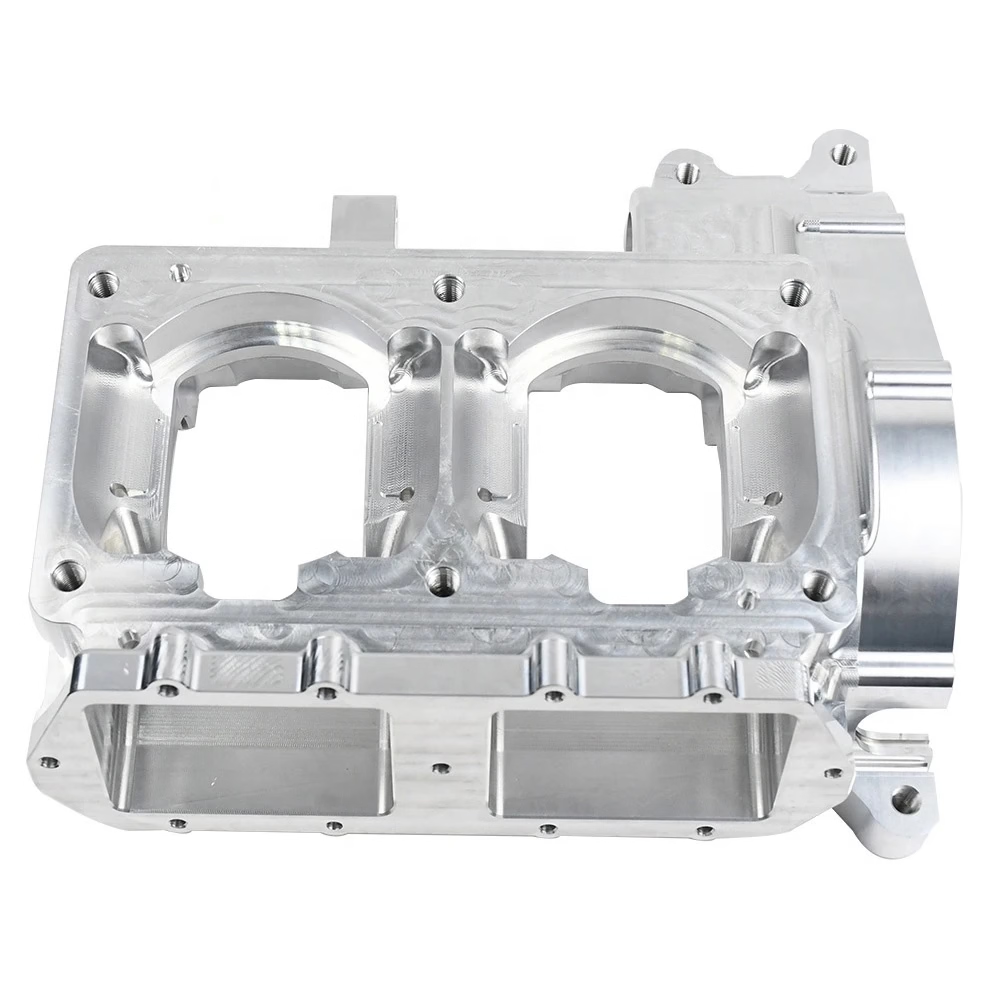
Most automobile engine custom parts are still metal, and the material split is predictable. Aluminum 6061-T6 and 7075 cover brackets, covers, adapter plates and intake flanges. Alloy steel 4140 and 4340 cover crank adapters, cam sprockets, dowel pins and anything taking cyclic load. Stainless 304, 316L and 17-4PH show up in exhaust-adjacent hardware and fuel system fittings.
Aluminum is the default for a reason. It machines at high feed rates, holds ±0.005 mm on a 5-axis center without drama, and takes anodizing in clear, black or hardcoat. Hardcoat anodizing gives a 25–50 μm surface layer that resists wear far better than bare 6061, which matters on throttle linkage and any sliding contact.
Steel is slower and costlier per part, but it is the only sensible answer for high-cycle fatigue. A 4340 crank adapter heat treated to 38–42 HRC will outlast an aluminum equivalent by a wide margin. Tell us the load case and we will say when metal is overkill and when plastic is a mistake.
Titanium TC4 (Ti-6Al-4V) sits between the two on weight and above both on cost. We use it for connecting-rod prototypes and valve train parts where mass reduction matters more than unit price. It cuts at roughly one quarter the speed of aluminum, so budget accordingly.
- 1Aluminum6061-T6, 7075, 2024, 6082. Fast, light, anodizes well
- 2Steel4140, 4340, 4130. For cyclic load and heat-treated wear surfaces
- 3Stainless304, 316L, 17-4PH. Fuel, exhaust and corrosion exposure
- 4TitaniumTC4 for mass-critical valve train and rod prototypes
PEEK vs metal for engine parts
Use this as a first filter, then confirm with your load case.
| Property | PEEK (unfilled) | 6061-T6 aluminum | 4140 steel |
|---|---|---|---|
| Density | 1.30 g/cm³ | 2.70 g/cm³ | 7.85 g/cm³ |
| Continuous use temp | ~250 °C | ~150 °C | ~500 °C |
| Thermal expansion | ~47 μm/m·K | ~23 μm/m·K | ~12 μm/m·K |
| Machined tolerance | ±0.02 mm typical | ±0.005 mm | ±0.005 mm |
| Wear resistance | Good, self-lubricating | Poor bare, good hardcoat | Excellent heat treated |
| Relative material cost | High | Low | Medium |
| Best for | Insulation, low load, wear | Brackets, covers, flanges | Cyclic load, high heat |
Suspension and accessory parts from the same shop
Engine work rarely arrives alone. The same RFQ usually includes suspension and accessory hardware: control arm bushings, camber plates, shock mounts, sway bar end links, pedal covers and mounting brackets. These parts share the same tolerance band and the same inspection routine, so it makes sense to machine them in one setup cycle.
For suspension, aluminum 7075 is common where stiffness matters and weight does not. Bushings often run POM or PEEK for low friction without grease. End links and hardware are usually 304 or 17-4PH because they live in road spray. Sheet metal brackets come off the same floor if the geometry is better formed than machined.
Accessories are where surface finish does the talking. Anodized aluminum shift knobs, oil caps and covers all need a clean brushed or bead-blasted surface before the color goes on. We do the finishing in house, which keeps the color batch consistent across a run. Laser marking handles logos and part numbers down to 1.5 mm character height.
If your project mixes engine, suspension and accessory parts, send the full set. We quote it as one job, machine the metal and plastic on separate schedules, and ship everything together after 100% inspection.
- 1SuspensionCamber plates, shock mounts, end links, bushing sleeves
- 2AccessoriesShift knobs, caps, covers, brackets, pedal pads
- 3FinishingAnodizing, powder coating, bead blasting, laser marking
Tolerances, finishes and inspection
We hold ±0.005 mm (±0.0002 in) on metal parts across 127 CNC machines, including 16 simultaneous 5-axis centers and 16 mill-turn centers. Maximum part size is 4,000 mm, with a Ø400 mm rotary table for parts that need multi-face access in one setup. PEEK and other plastics hold a wider band, typically ±0.02 mm, because the material moves with temperature and absorbs a little tool pressure.
Surface finish follows the function. Sealing faces and bearing bores get Ra 0.8–1.6 μm. Sliding contact and cosmetic surfaces go finer, Ra 0.2–0.8 μm. As-machined structural surfaces sit at Ra 1.6–3.2 μm, which is fine when nothing touches them.
Inspection is not a final gate only. We check incoming raw material, monitor dimensions in process, and inspect 100% of parts before shipment. Reports go out on request. Our historical qualification rate is 99.99%, and the historical probability of a late delivery is under 2%.
Quotation and a free DFM analysis come back within 12 hours. Production can start within 24 hours of a released drawing, and parts ship in 3–5 days. That timeline holds for prototypes and for runs past 10,000 pieces; there is no minimum order quantity.
- 1CertificationsISO 9001:2015, IATF 16949:2016, ISO 13485:2016, ISO 27001:2022
- 2Capacity3 plants, 7,600 m², 150 technicians, Dongguan and Singapore
- 3ConfidentialitySecure uploads, NDA available on request
Questions engineers ask before ordering
Can you machine PEEK and aluminum in the same order?
Yes. We run them on separate schedules because plastic needs dedicated tooling and clean coolant, then consolidate the shipment.
Send both material callouts in one RFQ and we will quote them together with the same tolerance note.
How do I know whether to specify PEEK or aluminum?
Start with temperature and load. If the part stays under 150 °C and carries structural load, aluminum 6061-T6 or 7075 is usually the cheaper, stiffer answer.
Go PEEK when you need thermal insulation, chemical resistance or low-friction sliding at temperatures aluminum cannot handle.
What tolerance can you hold on a PEEK engine part?
±0.02 mm is realistic for most PEEK features. Tighter callouts are possible on small bores, but the part will move with temperature once installed.
For metal parts we hold ±0.005 mm (±0.0002 in) as standard.
Do you offer prototypes before a production run?
Yes. There is no minimum order quantity, so a single prototype and a 10,000-piece run go through the same quoting process.
Rapid prototyping, vacuum casting and 3D printing are available when you need a fit check before committing to machined parts.
Which certifications cover automotive engine work?
IATF 16949:2016 is the relevant one for automotive production parts. We also hold ISO 9001:2015, ISO 13485:2016 and ISO 27001:2022.
Inspection reports can be issued with each shipment on request.
How do you protect drawings and CAD files?
Uploads go through a secure channel and are treated as confidential. We sign an NDA on request before any file exchange.
Our information security management is certified to ISO 27001:2022.
Send your engine part drawings
Upload a STEP file and get a quote with free DFM feedback within 12 hours.
12-hour quote±0.005 mmNo MOQNDA on request









