
Argentina's CNC industry booms, and what it changes for part buyers
The machining sector there is growing on aerospace, automotive and oil and gas demand. This page is for engineers and sourcing leads who want to know what that capacity actually machines, where it stops, and how to compare a quote from Rosario with one from Dongguan. Read it and you can judge fit, tolerance and risk before you send an RFQ.
What is actually driving the growth
Four things moved this sector forward, and only two of them are about machine tools.
Why Argentina's CNC industry booms right now
The growth comes from three demand streams arriving at once. Aerospace work near Brazilian and US aviation hubs pulled in tight-tolerance aluminum and titanium parts. Automotive investment, especially in transmission and EV drivetrain components, added volume work. Oil and gas in Neuquén keeps machine shops busy with 17-4PH and Inconel valve bodies. The sector also got a push from the Argentina Manufacturer initiative, which put funding and training behind smaller shops.
Two structural factors matter more than the policy headline. First, labor cost is low relative to Brazil or the US, and the technical universities in Buenos Aires, Córdoba and Rosario produce capable engineers. Second, geography. A shop in Córdoba ships to São Paulo in days, not weeks, which matters for tier-1 suppliers running lean inventory.
What this means for a buyer overseas: capacity exists, but it is not uniform. The top tier of Argentine shops runs 5-axis centers and CMMs. A longer tail runs 3-axis mills with manual inspection. Knowing which tier you are talking to decides whether your drawing is machinable there at all.
What the growth actually buys in machine capability
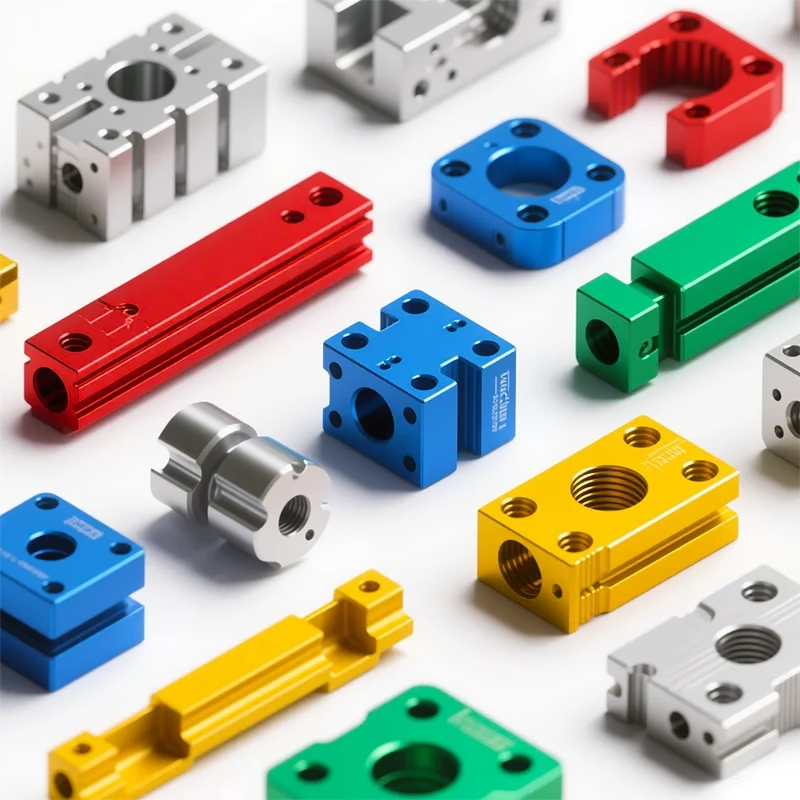
Investment in recent years went into 5-axis machining centers, mill-turn platforms and coordinate measuring machines. That combination covers most prismatic and rotational parts under 1 m. Complex impellers, turbine housings, surgical instrument bodies and engine brackets are all comfortably in range.
The limit is size and material, not axis count. Very large weldments and castings above roughly 1.5 m get scarce, and deep-hole work in Inconel still strains shops without high-pressure coolant. Titanium is machined, but cycle times climb and so does price. Ask about spindle taper, coolant pressure and tool life before you assume a 5-axis quote is competitive.
Metrology is the other half. A shop with a CMM can hand you a report with actual position values, not just a pass or fail. If your drawing calls out GD&T with tight true position, confirm the inspection method in writing. A first article report on a CMM is worth more than a certificate on the wall.
- 1Good fitPrismatic parts to 1 m, aluminum and stainless, moderate to tight tolerance
- 2WorkableTitanium and Inconel parts with simple geometry and generous cycle time budget
- 3Weak fitVery large weldments, deep small holes, high-volume low-cost stamping replacements
How to compare an Argentine quote with an Asian one
Price is the easy column. The hard columns are tolerance repeatability, documentation and logistics. A quote that lands 20 percent lower often carries a looser inspection plan, and you find that out at incoming inspection, not at PO.
Ask every supplier the same five questions: which machine will run the part, what tolerance they hold across a production run, how they inspect, what report you get, and what happens when a dimension drifts. A shop that answers all five in one email is worth a longer conversation.
Lead time is where geography cuts both ways. Argentine shops reach Mercosur customers fast. For a buyer in Europe or the US, transit adds days and customs adds variables, so the production speed advantage narrows. If your program runs on a tight build schedule, compare door-to-door time, not just machining time.
Capability snapshot: Argentina vs. a Dongguan contract shop
Same part family, different strengths. Numbers are typical ranges, not a ranking.
| Factor | Argentina (top-tier shops) | GreatLight (Dongguan) | What to check |
|---|---|---|---|
| Axis count | 3 to 5 axis common | 16 simultaneous 5-axis centers | Which machine runs your part |
| Tolerance | ±0.01 mm typical | ±0.005 mm (0.0002 in) | Held across the run, not first piece |
| Max part size | About 1 m typical | 4,000 mm maximum processing size | Fixture and travel limits |
| Materials | Aluminum, steel, some Ti | Aluminum, stainless, steel, Ti, Inconel | Grade and stock availability |
| Finishing | Often outsourced | Anodizing, plating, black oxide in house | Who owns the finish spec |
| Inspection | CMM at top shops | 100% inspection before shipment | Report type and sample rate |
| Lead time | Fast to Mercosur | Quote in 12 hours, ship in 3–5 days | Door-to-door, not shop floor |
When to use capacity there, and when not to
Use Argentine shops when your parts are medium-sized, your volumes are moderate, and your delivery point is inside South America. The proximity advantage is real and it compounds on repeat orders. For a Brazilian tier-1, a Córdoba supplier can beat an overseas one on total landed cost and on response time to a line-down event.
Look elsewhere when tolerance is tighter than ±0.01 mm across a run, when the part exceeds about 1 m, or when you need a full material and finish certificate chain from a single source. Those cases need a shop that controls heat treat, finishing and metrology under one roof, because splitting them across vendors adds handoffs and hiding places for error.
There is no single answer. The boom added real capability, and it also added a lot of shops that look similar on a website. The differentiator is the inspection report you receive with the parts. Ask for one before you place the order. A supplier who hesitates has told you something useful.
Questions engineers ask next
Can an Argentine shop hold ±0.005 mm on a production run?
Some can, on the right part and the right machine. It depends on geometry, material and thermal control, not on the country.
Ask for the machine model, the fixture concept and a CMM report from a comparable part. If they cannot show run-level data, assume ±0.01 mm at best.
What part sizes are realistic there?
Prismatic parts up to roughly 1 m are comfortable. Beyond that, machine travel and fixture stiffness become the constraint.
For larger work, a shop with 4,000 mm travel and a Ø400 mm rotary table covers the range without a special setup.
How do I protect my design when sourcing overseas?
Send STEP files rather than native CAD where you can, and put an NDA in place before the RFQ, not after.
Encrypted upload portals matter more than the NDA text. Ask how files are stored and who can open them.
Is a lower hourly rate always cheaper?
No. Cycle time, scrap rate, fixturing and inspection all sit on top of the rate.
A shop with a faster spindle and better tooling can beat a cheap rate on total part cost, especially in titanium.
What should be in the first article report?
Dimensional results against every ballooned drawing feature, material cert, and any finish thickness measurement.
If GD&T is on the drawing, the report should show actual values, not just pass or fail.
Send the drawing, get a real answer
Upload your STEP file and we return a quote with free DFM analysis within 12 hours. No minimum order quantity, from one prototype to 10,000+ part runs.
12-hour quote100% inspection±0.005 mmNDA on request









