
When evaluating CNC machinery for precision manufacturing, one common question we encounter from clients is: Are Avid CNC machines made in the USA? This query speaks to a broader consideration in our industry regarding supply chain transparency, quality assurance, and the value of origin. As a senior manufacturing engineer who has specified and worked with equipment from countless global brands, I can provide a detailed perspective.
The straightforward answer is that Avid CNC (formerly CNC Router Parts) designs, engineers, and assembles its machine kits and systems in the United States, specifically in Bellingham, Washington. The company emphasizes American-based design, support, and final assembly. However, like the vast majority of industrial equipment manufacturers worldwide, they source individual components, such as linear rails, bearings, motors, and electronics, from a global supply chain that includes high-quality producers in Asia and Europe.
This model—U.S. design and assembly with globally sourced components—is not unique to Avid CNC; it is a standard and practical approach in today’s interconnected manufacturing landscape. It allows companies to leverage specialized international expertise while maintaining control over critical design integration, quality of assembly, and direct customer support.
Why the “Country of Origin” Question Matters in Precision Machining
For a professional workshop like ours at GreatLight Metal, the decision to invest in capital equipment goes far beyond a simple “Made In” label. When we evaluate a CNC machine brand—whether for our own factory floor or when advising clients on their procurement—we dissect its value through a multi-layered engineering lens:
1. Design Philosophy and Intended Application:
Avid CNC primarily designs robust, modular CNC router and plasma cutting systems. They excel in applications like woodworking, sign-making, prototyping with softer materials, and light-duty aluminum machining. This is distinct from the ultra-high-precision, rigid 5-axis CNC machining centers we operate for machining aerospace-grade titanium or medical implant stainless steel. The “best” machine is entirely defined by the application’s requirements for precision, rigidity, material, and volumetric capacity.
2. The Critical Importance of Localized Support and Documentation:
A machine’s origin often correlates with the accessibility and quality of its support. A significant advantage of a U.S.-based company like Avid is the proximity of engineering support, availability of comprehensive English documentation, and easier access to spare parts logistics. For a manufacturing business, minimizing machine downtime is paramount. The ability to quickly get technical advice or a replacement part can outweigh a marginal cost saving from a machine with opaque support channels.
3. System Rigidity and Precision Grade:
The ultimate precision of a machined part is a function of the machine tool’s static and dynamic rigidity, its thermal stability, and the quality of its feedback systems. While assembly location matters, the precision is engineered through the synergy of:
Component Quality: High-grade German or Japanese linear guides, precision-ground ball screws, and reliable spindle units.
Structural Design: Robust welding, stress-relieving of frames, and effective damping.
Control System: The sophistication of the CNC controller (e.g., Centroid, Siemens, Fanuc) and its calibration.
The GreatLight Perspective: Matching the Machine to the Mission
At GreatLight Metal Tech Co., LTD., our philosophy is agnostic to brand nationality but fanatical about fitness for purpose and total lifecycle value. Our factory in Dongguan is equipped with a strategic mix of machinery:
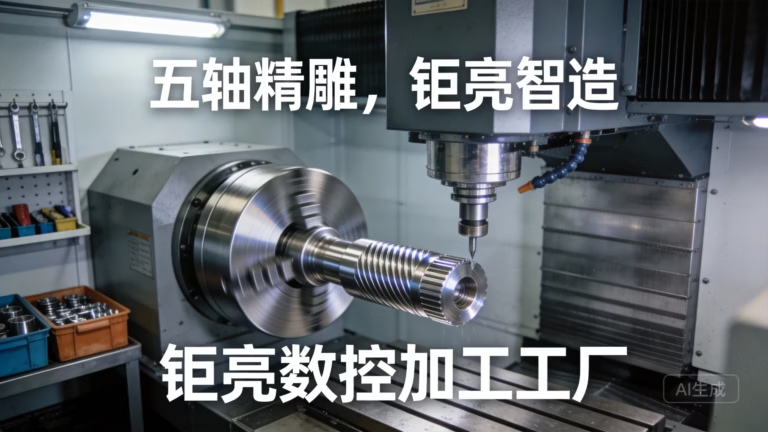
For High-Speed, High-Precision Complex Components: We invest in advanced 5-axis CNC machining centers from top-tier international builders. These machines are the workhorses for producing components with tolerances within ±0.001mm for industries like automotive, aerospace, and medical devices.
For Prototyping, Tooling, and Auxiliary Tasks: We utilize highly capable 3-axis and 4-axis CNC milling machines and routers. For certain large-format or specialized tasks, a well-designed, rigid, and well-supported machine from a company like Avid CNC could be a perfect and cost-effective solution, especially when supported by our in-house engineering team for process optimization.
This balanced approach ensures we have the right technological tool for every client’s challenge, whether it’s a one-off prototype or a production run of 10,000 precision components.
Conclusion: Looking Beyond the Label
So, are Avid CNC machines made in the USA? Yes, they are American-designed and assembled, representing a solid choice within their target market segment. The more profound lesson for anyone in precision parts machining and customization is to look beyond the country-of-origin label. Scrutinize the machine’s technical specifications against your specific precision, material, and volume requirements. Evaluate the manufacturer’s reputation for support and the ecosystem of available parts and knowledge. The most “valuable” machine is the one that reliably, accurately, and efficiently produces your parts with the lowest total cost of ownership.
In our globalized industry, excellence is not the monopoly of any single geography. It is the result of thoughtful design, quality component integration, meticulous assembly, and unwavering support—a principle we apply both in selecting our own equipment and in delivering precision CNC machining services to our clients worldwide.
Frequently Asked Questions (FAQ)
Q1: For machining aluminum parts with tight tolerances (±0.05mm), is an Avid CNC router sufficient?
A: It depends on the part size and complexity. For smaller, less complex 2.5D aluminum parts, a heavily built CNC router with a high-frequency spindle can be adequate. However, for complex 3D contours, high-volume material removal, or holding tolerances below ±0.02mm, a dedicated, rigid vertical machining center (VMC) is a more appropriate and reliable choice due to its superior rigidity, coolant systems, and enclosed construction.
Q2: What are the key advantages of choosing a U.S.-assembled CNC machine for a workshop in Asia?
A: The primary advantages are standardized English documentation, direct access to design engineering teams in a compatible time zone (for support), and often a more transparent supply chain for upgrade kits and spare parts. However, local agent support is crucial. It’s vital to assess the responsiveness and technical skill of the local distributor or service partner.
Q3: How does GreatLight Metal ensure precision when you use equipment from various global sources?
A: Precision is ensured through our system, not just a single machine. We implement a rigorous process that includes:
Machine Calibration & Maintenance: Regular laser calibration and preventive maintenance according to strict schedules.
In-Process Verification: Using on-machine probes and a full suite of offline metrology equipment (CMMs, optical scanners, profilometers) to verify parts at every stage.
Process Engineering: Our engineers develop optimized machining strategies, toolpaths, and fixturing methods to maximize the capability of each machine, ensuring it produces parts that meet our stringent quality management system certified to ISO 9001:2015, IATF 16949, and ISO 13485 standards.
Q4: When sourcing custom precision parts, should I be concerned about what machines my supplier uses?
A: Your concern should be focused on the output specifications and quality guarantees, not the specific machine brand. A professional manufacturer like GreatLight Metal will select the most efficient and accurate process (be it 3-axis, 5-axis, turning, or grinding) to meet your print’s requirements. Your due diligence should be on the supplier’s quality certifications, measurement reports, and proven track record in your industry, rather than auditing their equipment list.



















