
Application challenges of Youjia five-axis machining centers on complex parts
This page is for engineers and buyers who are quoting complex parts and need to decide whether a Youjia five-axis machining center is the right machine. It covers where the configuration wins, where it runs into trouble, and how to compare it against 3-axis, 4-axis and mill-turn options.
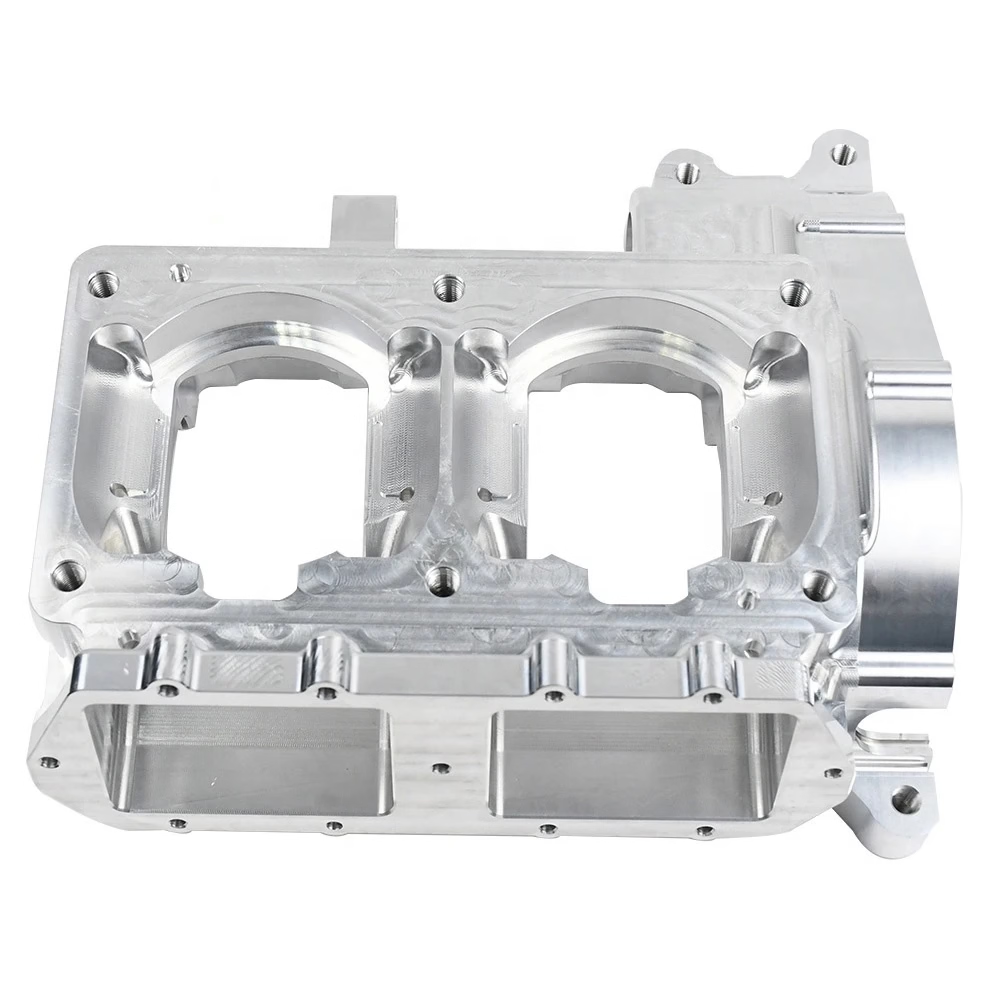
What this page covers
Where the Youjia five-axis platform pays off on complex geometry, and the constraints that decide the setup.
How a Youjia five-axis center differs from a 3-axis mill
A Youjia five-axis machining center adds two rotary axes to the usual X, Y and Z linear motion. Depending on the model, those axes are A and B or A and C, and they let the tool approach the part from any direction in a single setup. That change matters most when a part has features on five or six faces, or when the geometry has compound angles that would otherwise need three or four separate fixtures.
The real difference is not the extra axes themselves. It is what happens to the datum. Every time a part moves to a new fixture, the stack-up of positioning error grows. A five-axis machine keeps one work coordinate system for the whole cut, so bores, faces and pockets stay related to each other. For a hydraulic manifold with cross-drilled passages, that single-setup relationship is often the difference between a part that seals and one that leaks.
Simultaneous five-axis motion also lets the tool stay normal to a curved surface. On a contoured impeller or a turbine blade, a ball nose cutter can be kept at a constant lead angle, which spreads wear across the flute and holds surface finish. The trade-off is that the post-processor, the CAM strategy and the operator skill all have to be better than what a 3-axis job needs.
- 1Fewer setupsOne work coordinate system, less re-datum error.
- 2Tool accessShort, stiff tools reach undercuts and deep pockets.
- 3Surface controlConstant lead angle keeps finish consistent on curves.
- 4Higher programming costCAM, post and verification take longer to prepare.
Where the Youjia platform fits best
The strongest case is a part that is expensive to scrap and awkward to hold. Titanium and Inconel aerospace brackets fall into this group. A single re-clamp on a thin-walled Ti-6Al-4V frame can spring the part out of tolerance, so eliminating setups removes a whole class of risk. The same logic applies to medical instrument housings with bores that must stay coaxial to a mounting face.
Automotive and EV work benefits for a different reason. Complex transmission housings, motor end plates and die-cast covers often carry drafted walls, angled bosses and oil galleries. Five-axis lets one machine finish the sealing face, the bearing bores and the bolt pattern without a second op. That shortens the process route and reduces the number of fixtures the shop has to design, build and store.
Robotics and automation parts sit in the middle. A humanoid joint housing or a harmonic drive component has intersecting bores at angles that a 3-axis machine cannot reach in one setup. The part is not huge, maybe 200–400 mm across, but the tolerance stack between those bores is tight. A compact five-axis center with a Ø400 mm rotary table handles this size well.
Not every complex part belongs on a five-axis machine. A flat plate with pockets and holes is faster and cheaper on a 3-axis mill. A long shaft with concentric turning features is a mill-turn job. Five-axis earns its cost when the geometry, the tolerance stack or the material risk justifies one setup.
- 1Aerospace bracketsThin walls, titanium, high scrap cost.
- 2EV housingsAngled bosses and sealing faces in one op.
- 3Medical housingsCoaxial bores tied to a mounting face.
- 4Robotics jointsIntersecting bores, 200–400 mm envelope.
Which machine type fits the part
Use this as a first filter before quoting a complex part.
| Part characteristic | Best machine type | Why |
|---|---|---|
| Features on 5+ faces | 5-axis | One setup, no re-datum |
| Compound angles and undercuts | 5-axis | Tool can reach from any direction |
| Flat plate, pockets, through holes | 3-axis | Fast, simple, low fixture cost |
| Concentric turning features | Mill-turn | Turning plus milling in one cycle |
| Deep pockets on 4 faces | 4-axis | Indexed rotary, lower programming load |
| Thin walls, hard alloy | 5-axis | Fewer clamps, less spring-back |
| Large frame up to 4,000 mm | 5-axis gantry | Travel matches part length |
The challenges that decide whether five-axis pays off
Cost is the first hurdle. A five-axis hour is more expensive than a 3-axis hour, and the programming is more involved. If a part can be made in two 3-axis setups with a simple fixture and still holds tolerance, moving it to five-axis adds cost without adding value. The decision should be driven by tolerance stack and scrap risk, not by machine prestige.
Thermal behavior is a second issue. The rotary axes generate heat, and on long cycles the machine can drift. A part that runs for six hours may need a warm-up cycle and in-process probing to hold ±0.005 mm. This is manageable, but it has to be planned into the process rather than discovered at final inspection.
Tool deflection shows up differently on five-axis. Because the tool can be oriented to reach a deep pocket, it is often longer and thinner than the 3-axis equivalent. That reduces stiffness. Cutting forces can push the tool off the intended path, so step-over and feed have to be chosen with the tool length in mind.
Operator and CAM skill is the quiet constraint. A good five-axis program needs a verified post-processor, a simulated tool path and an operator who understands the rotary limits. A shop without that bench strength will fight scrap and slow cycles even on a capable machine. This is where the application challenges youjia five-axis users report most often come from, and it is a people problem before it is a machine problem.
- 1Hourly costHigher than 3-axis; needs a real justification.
- 2Thermal driftLong cycles need warm-up and probing.
- 3Tool stiffnessLonger reach means lighter cuts.
- 4Skill benchCAM, post and operator must all be ready.
How to prepare a complex part for a five-axis quote
Start with the datum strategy. Mark on the drawing which faces and bores must stay related, and note which ones can be re-datumed without risk. This tells the process engineer whether one setup is enough or whether a hybrid route makes more sense. It also exposes any feature that a five-axis machine simply cannot reach.
Next, check the stock and the material. A 7075 aluminium bracket at 200 mm is straightforward. The same shape in Inconel needs more passes, more tool changes and a stiffer setup. Material choice affects cycle time more than geometry on hard alloys, so state the alloy and temper clearly on the RFQ.
Finally, list the tolerances that actually matter. Calling out ±0.005 mm on every dimension forces unnecessary inspection and slows the job. Reserve tight tolerance for the fits and the mating faces. Everything else can sit at general machining tolerance, which keeps the process honest and the cost down.
If the part is still in design, a DFM review before quoting is worth the time. Small changes to a fillet radius, a wall thickness or a boss height can turn a part that needs two setups into one that needs a single five-axis cycle. GreatLight offers free DFM analysis with every quote, and the feedback usually comes back within 12 hours.
- 1Datum firstMark related faces and bores on the print.
- 2State the alloy7075 and Inconel behave very differently.
- 3Tolerance where it countsTight only on fits and mating faces.
- 4Review earlyDFM before quoting saves setups.
Common questions
When is a five-axis machine the wrong choice?
When the part is flat, prismatic and can be made in two simple 3-axis setups with a stable fixture. Also when the only reason is a single angled hole that a sine plate or a drill fixture can handle.
The machine is not the bottleneck in those cases. Fixture design is, and 3-axis is cheaper and faster to set up.
Can a Youjia five-axis center hold ±0.005 mm on a long cycle?
Yes, with planning. The machine is capable of that tolerance, but thermal drift over a multi-hour cycle has to be controlled with a warm-up routine and in-process probing.
On hard alloys or thin walls, the limiting factor is usually tool deflection, not the machine geometry.
What part size fits the simultaneous five-axis centers?
GreatLight runs 16 simultaneous five-axis centers. Work envelopes include 750 × 1,150 × 550 mm, 600 × 600 × 600 mm, and compact cells at 500 × 500 × 450 mm and 500 × 310 × 200 mm with a Ø400 mm rotary table.
Larger frames can go to a five-axis gantry machine rated up to 4,000 mm in length.
Which materials are practical on five-axis?
Aluminium grades such as 6061, 7075 and 6082 cut well and hold tolerance. Stainless 304, 316 and 17-4PH, along with titanium TC4 and Inconel, are common but slower.
Hard alloys need lighter cuts and more tool changes, so quote lead time reflects the material, not just the geometry.
How much does programming add to a five-axis job?
It depends on the surface complexity. A part with a few angled faces is close to a 3-axis programming load. A contoured impeller with continuous five-axis motion can take several times longer to program and verify.
That programming time is part of the quote, so send a STEP file and the tolerance callouts for the clearest answer.
Do you sign an NDA before reviewing drawings?
Yes. Uploads are secure and confidential, and an NDA is available on request before any file is shared.
Send the model and the critical tolerance list, and the DFM feedback comes back with the quote.
Send a complex part and get a real process answer
Upload a STEP file and the tolerance callouts. We will tell you whether five-axis is the right route, and quote it either way.
12-hour quoteFree DFM analysis100% inspectionNDA on request









