
9060 Mini CNC Router with Rotating 4 Axis Wooden Engraver
This page explains what a mini CNC router with rotating 4 axis can and cannot do, how the rotary axis changes toolpaths and workholding, and how to decide between a desktop rotary router and a production mill-turn center. It is written for workshop owners, product engineers and technical buyers who need to judge the machine before they spend.
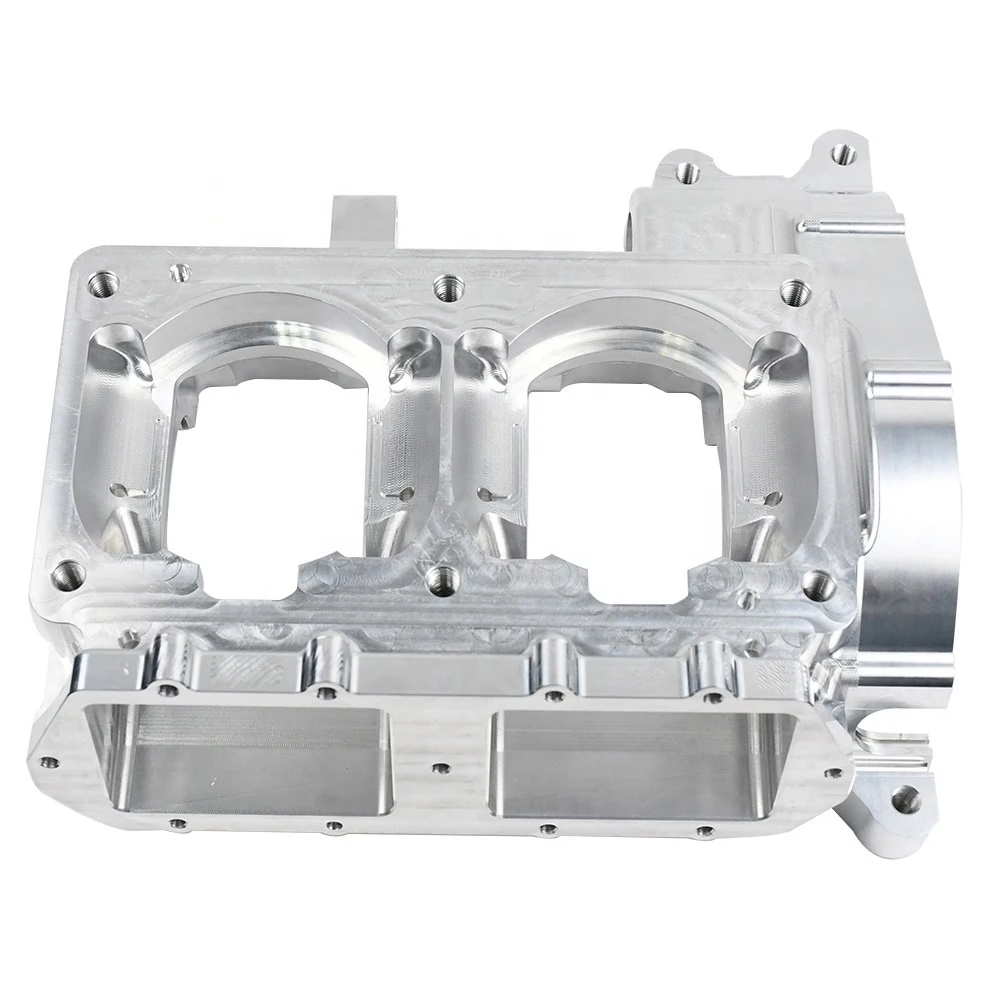
What a rotating 4 axis router actually adds
A 3 axis router moves in X, Y and Z. The fourth axis turns the workpiece, so the cutter can reach around it.
The fourth axis is a work-holding decision, not a speed upgrade
Adding a rotary head to a 9060 gantry router changes how the part is held more than how fast the spindle cuts. The bed still travels in X, Y and Z. The A axis replaces the flat vacuum table for cylindrical jobs: a chuck clamps the stock on its centerline, and the controller turns it in steps while the cutter follows a wrapped toolpath. Setup time drops on round parts because you stop re-fixturing between faces.
The trade-off is rigidity. A rotary axis mounted on a moving gantry sees more flex than a cast-iron mill bed, so deep cuts in hardwood or aluminium tend to chatter. Take lighter passes and expect to trade cycle time for the ability to reach all around the part in one setup.
This is why the machine suits engraving, relief carving and light profile work in wood, MDF, acrylic and modelling foam. It is not a substitute for a machining center when the job calls for tight tolerances in steel or a mirror finish.
- 1Good fitTurned legs, chess pieces, gun stocks, instrument necks, cylindrical signage.
- 2Marginal fitLong thin spindles that deflect under cutter load.
- 3Wrong fitSteel shafts, press-fit bores, parts needing Ra 0.2–0.8 μm.
Chucks, tailstocks and the limits of a desktop rotary axis
A typical 9060 rotary kit ships with a 3-jaw chuck and an optional tailstock. The chuck holds one end; the tailstock supports the other through a live center. Without the tailstock, anything longer than roughly three times its diameter will whip and cut oversize in the middle. With it, you can turn a 600 mm baluster that stays concentric along its full length.
Stock diameter is capped by the swing over the bed and by how far the gantry can rise. Most 9060 frames clear around 100–150 mm diameter without a riser block. Beyond that, the chuck jaws and the gantry crossbeam start to interfere. Measure the swing before you buy stock, not after.
For square or irregular blanks, a 4-jaw independent chuck or a custom fixture plate beats a self-centering chuck. It takes longer to dial in, but it holds a rectangular blank on its true centerline, which matters when you are carving a symmetrical shape.
Rotary router vs production 4 axis mill
Both turn the part. They differ in rigidity, envelope and what they can hold.
| Factor | 9060 rotary router | Production 4 axis mill |
|---|---|---|
| Frame | Aluminium gantry, bolted | Cast iron or welded steel |
| Typical stock | Wood, MDF, acrylic, foam | Aluminium, steel, stainless, titanium |
| Diameter range | About 100–150 mm swing | Larger, riser-dependent |
| Tolerance | Loose, setup-dependent | ±0.005 mm achievable |
| Finish | Visible tool marks common | Ra 0.8–1.6 μm typical |
| Best use | One-off carvings, prototypes | Repeat runs, functional parts |
| Batch size | Single pieces to short runs | One prototype to 10,000+ parts |
How the CAM side changes with a wrapped axis
The controller does not see a cylinder. It sees a flat Y axis that has been rolled around the A axis. That is the wrapped toolpath model, and it means your post-processor has to output A moves instead of Y moves for anything that wraps. Get this wrong and the part comes out mirrored or stretched.
Stepover matters more here than on a flat bed. On a cylinder, a 0.1 mm stepover at the surface becomes a wider arc gap as radius grows, so surface finish varies around the part. Many operators reduce stepover near the visible face and open it up on hidden surfaces to save time.
For text and logos, you usually want the toolpath to follow the rotation, not cut across it. Cutting along the A axis leaves a continuous line; cutting across it leaves scallops between passes that are hard to sand out on a curved surface.
- 1Post-processorMust support wrapped A output; check before you commit a job.
- 2Zero pointSet A zero on a feature you can re-find, not on the chuck jaw.
- 3FeedsStart about 30% lower than a flat cut at the same depth.
- 4RoughingLeave 0.3–0.5 mm radial stock for the finishing pass.
When the wood part needs a metal counterpart
Wooden engravings rarely ship alone. A turned handle gets a machined aluminium collar, a carved housing gets a stainless bracket, a prototype lamp gets a machined base. The rotary router makes the wood side; the metal side goes to a mill.
GreatLight runs 127 high-precision CNC machines across three plants in Dongguan and Singapore, including 12 four-axis mills and 16 simultaneous 5-axis machining centers. We hold ±0.005 mm and Ra 0.8–1.6 μm on metal parts, inspect 100% before shipment, and work from one prototype to 10,000+ part runs with no minimum order quantity.
A common pattern: you carve the wooden body on the 9060, and we machine the aluminium insert, the threaded bushing and the mounting plate to fit it. We quote and return a free DFM analysis within 12 hours, and production can start within 24 hours. Uploads stay confidential; an NDA is available on request.
Questions engineers ask before buying
Can a 9060 rotary router cut aluminium?
It can scratch-cut 6061 with light passes, a sharp single-flute cutter and air blast for chip clearing. It will not hold tolerance on a production aluminium job.
For functional aluminium parts, a 4 axis mill is the right tool. Our four-axis mills hold ±0.005 mm and finish to Ra 0.8–1.6 μm.
What is the largest diameter I can turn?
Most 9060 frames swing around 100–150 mm over the bed without a riser. The chuck jaws and gantry crossbeam set the real limit.
If you need more, add a riser block and re-check Z travel. Extra swing eats Z clearance.
Do I need a tailstock for every job?
No. Short parts held in the chuck only are fine. Use the tailstock once length exceeds about three times diameter, or the middle of the part will deflect and cut oversize.
How do I keep A zero repeatable between setups?
Datum off a machined face or a dowel pin in a fixture plate, not off the chuck jaw. Then re-find that feature with an edge finder or probe.
Record the offset in your CAM setup sheet so the next run starts from the same number.
Can you machine the metal parts that fit my carved wood parts?
Yes. Send the mating dimensions or the wooden part itself and we will machine the insert, bushing or bracket in aluminium, stainless, brass or titanium.
We quote within 12 hours with a free DFM analysis, and parts ship in 3–5 days.
What file formats work for a wrapped toolpath?
Most CAM packages output wrapped A moves from a standard 3D model. Export STEP or STL and check that your post-processor supports rotary output.
Test on scrap stock first. A mirrored A move is easy to miss until the part is half cut.
Send the wood part. We will machine the metal that fits it.
Upload your drawing or model and get a quotation with a free DFM analysis within 12 hours.
12-hour quote100% inspectionNDA on request









