
5 Axis CNC Machinable Materials
This page lists the metals and plastics we run on simultaneous 5-axis centers, how each one behaves in the cut, and where it stops making sense. It is written for design engineers and sourcing staff who need to lock a material before quoting.
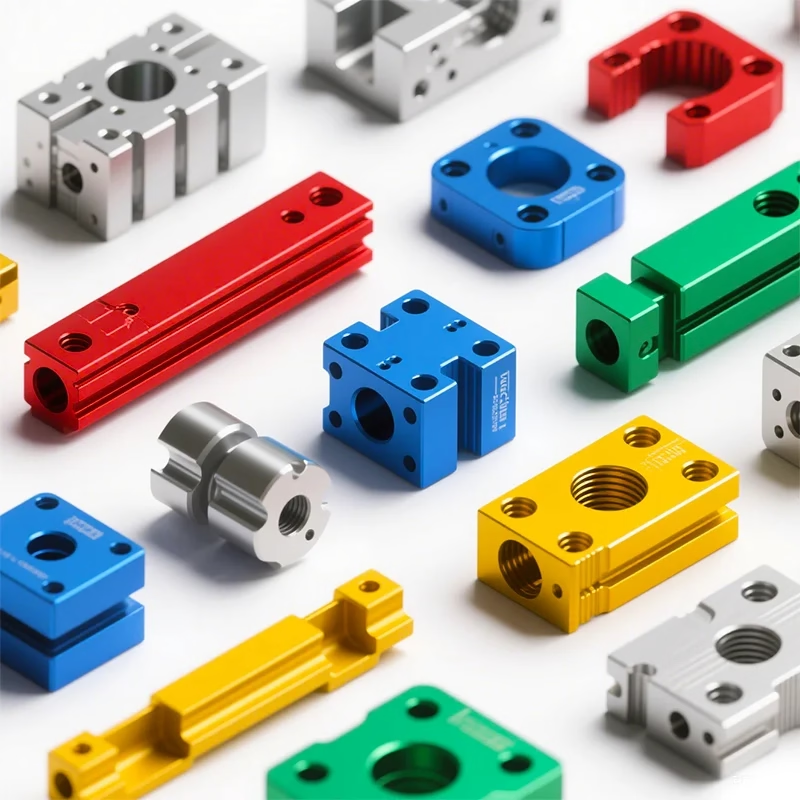
What Makes a Material 5 Axis CNC Machinable
Almost any solid stock can be cut on a 5-axis center. The real question is whether the part geometry, tolerance and surface finish justify the setup.
Aluminum Alloys: The Default Choice
Aluminum is the first material we suggest for most 5-axis work. It cuts fast, holds tight tolerances, and the tool load stays low, so a 4,000 mm part can be roughed and finished in one setup without thermal drift becoming a problem. We keep 6061, 6061-T6, 2024, 5052, 5083, 6063, 6082, 7075 and ADC12 in the material list.
Grade matters more than people expect. 6061-T6 gives a good balance of strength and weldability, and it anodizes cleanly. 7075 machines well and takes a mirror finish, but it is less corrosion resistant and costs more. 2024 has higher fatigue strength and is common in aerospace brackets, though it needs a protective finish. ADC12 is a die-casting alloy; we machine it when a casting needs secondary features.
Watch thin walls. Aluminum deflects under cutting force, and a 0.5 mm wall on a 5-axis contour will sing unless the toolpath is adjusted. The fix is usually a lighter radial engagement rather than a slower feed. Tell us the wall thickness at quoting and we plan the strategy around it.
Aluminum is a poor fit when the part sees continuous abrasion or high temperature. Above roughly 150 °C it loses strength quickly. For those cases we move to steel or titanium.
- 1Good fitHousings, brackets, manifolds, heat sinks, prototype frames
- 2Less idealHigh-wear surfaces, parts running above 150 °C
Titanium, Stainless and Carbon Steel
Titanium is where 5-axis pays for itself. TA1, TA2 and TC4 (Ti-6Al-4V) are all in our list, and complex impeller or medical geometry that would need three fixtures on a 3-axis machine can be cut in one continuous pass. The trade-off is heat. Titanium conducts heat poorly, so the cutter takes the temperature instead of the chip. We run lower surface speeds, higher coolant pressure, and sharp uncoated or AlTiN tools.
TC4 gives roughly twice the strength of 6061 at about 60% of the weight of steel. It also galls, which means threads and sliding surfaces need attention. Use thread milling rather than tapping for anything under M6, and specify a finish on wear faces.
Stainless steel covers 303, 304, 316, 316L, 420, 430, 431, 440C and 17-4PH (SUS630). 303 is the free-machining grade and the easiest to run. 304 and 316 are tougher, work-harden quickly, and need a constant feed so the tool never rubs. 17-4PH machines in the annealed condition and then ages to high strength, which suits pump shafts and valve bodies.
Carbon steel rounds out the group: 1018, 1045, 4130, 4140, 4340, A36 and tool steel. These are inexpensive and strong, and they cut predictably. The catch is corrosion. Unless the part is painted, plated or black oxided, plain carbon steel will rust in service.
With any of these three families, the 5-axis advantage is fewer setups. Every re-clamp on a hard material adds error and handling time, and a single continuous toolpath removes both.
- 1TitaniumAerospace, medical, motorsport. Slow speeds, heavy coolant
- 2StainlessFood, chemical, marine. Control work hardening
- 3Carbon steelShafts, plates, fixtures. Needs a protective finish
Machinable Plastics: PC, POM, PA, PP and PTFE
Plastics cut on the same 5-axis centers, but the rules change. Thermal expansion is high, so a part checked hot will not match the drawing when it cools. We rough, let the part rest, then finish. On a long part this is the difference between a good tolerance and a rejected one.
Polycarbonate (PC) is tough and transparent. It is used for guards, light covers and manifolds. It scratches easily and stress-cracks around sharp internal corners, so radii matter. POM (acetal) is the most predictable plastic we machine. It holds ±0.05 mm on a well-supported part, has low friction, and is a natural fit for gears, bushings and valve bodies.
Nylon (PA) is strong and abrasion resistant but absorbs moisture, which changes dimensions after machining. If a nylon part has a tight tolerance, specify it dry and expect movement. PP is chemical resistant and cheap, good for tanks, lids and fluid parts, but it is soft and gummy; sharp tools and climb milling keep the edge clean.
PTFE has the lowest friction and the widest chemical resistance of the group. It also creeps under load and expands a lot with heat, so it suits seals, insulators and lab hardware rather than structural parts. We also run ABS, PMMA, PEEK, HDPE and carbon fibre when the application calls for it.
PEEK sits at the top of the plastic range. It keeps strength near 250 °C and survives steam and many solvents. It is also expensive and abrasive to tooling, so we only recommend it when the temperature or chemical load rules out cheaper options.
- 1POMGears, bushings, precision mechanical parts
- 2PCTransparent covers, guards, impact parts
- 3PAWear strips, rollers. Expect moisture movement
- 4PTFESeals, insulators, chemical hardware
Material Comparison for 5-Axis Machining
Typical shop-floor behavior. Values are for general guidance, not a specification.
| Material | Machinability | Typical finish | Watch out for |
|---|---|---|---|
| 6061-T6 aluminum | Excellent | Ra 0.8–1.6 μm | Thin-wall deflection |
| 7075 aluminum | Good | Ra 0.2–0.8 μm | Lower corrosion resistance |
| TC4 titanium | Poor | Ra 0.8–1.6 μm | Heat buildup, galling |
| 303 stainless | Good | Ra 0.8–1.6 μm | Little; free-machining grade |
| 316L stainless | Fair | Ra 0.8–1.6 μm | Work hardening |
| 17-4PH stainless | Fair | Ra 0.8–1.6 μm | Aging distortion |
| 4140 steel | Good | Ra 1.6–3.2 μm | Rust without a finish |
| POM (acetal) | Excellent | Ra 0.8–1.6 μm | Heat growth on long cuts |
| PC | Good | Ra 0.8–1.6 μm | Stress cracking at corners |
| PA (nylon) | Good | Ra 1.6–3.2 μm | Moisture swelling |
| PP | Fair | Ra 1.6–3.2 μm | Gummy chips, soft edges |
| PTFE | Good | Ra 1.6–3.2 μm | Creep and thermal growth |
How to Choose: Five Checks Before You Quote
Start with mechanical load. If the part carries a structural load, the yield strength decides the family before anything else. Aluminum covers most brackets and housings. Steel and titanium cover the rest. Plastics are for low-load parts, wear surfaces and electrical insulation.
Then look at the environment. Temperature, moisture, chemicals and UV each remove options. A part that sees salt spray should not be 7075 without a coating. A part that sees steam should not be nylon. PTFE and PEEK handle chemical exposure that would destroy most metals.
Machinability is the third check, and it drives cost more than material price does. Titanium stock costs more than aluminum and takes several times longer to cut. A 316L part with deep pockets may need more spindle time than a 4140 part of the same shape. When the design allows, a small geometry change can cut cycle time significantly.
Surface finish is the fourth. If the drawing calls for Ra 0.2–0.8 μm, that is achievable on aluminum and on many plastics with the right toolpath, but it adds a finishing pass. On titanium it is slow. Ask whether the finish is functional or cosmetic; cosmetic finishes on non-critical faces often cost more than they return.
Finally, cost and quantity. For one prototype, pick the material that machines easiest and meets the load. For a 10,000-part run, it is worth revisiting the choice, because a cheaper alloy that cuts 20% faster can beat a premium alloy that needs extra operations. We machine from one part to full production runs with no minimum order quantity.
If two materials both pass the checks, run the cheaper one first and test it. A prototype is the least expensive place to find out that a substitution works.
- 1LoadStrength and stiffness decide the family
- 2EnvironmentHeat, moisture, chemicals, UV
- 3MachinabilityCycle time usually outweighs stock price
- 4FinishFunctional versus cosmetic surfaces
- 5QuantityRevisit the choice at production volume
Process Notes That Affect Material Choice
High-speed machining changes what is practical. With light radial cuts and high spindle speeds, hardened steel and titanium become more economical because the tool stays cool and the chips clear. It also reduces the force on thin aluminum walls, which is why we use it on large, lightly supported parts. We hold ±0.005 mm (±0.0002 in) on qualifying features across our 16 simultaneous 5-axis centers.
Adaptive toolpaths matter for hard materials. Instead of a fixed stepover, the control adjusts engagement to keep the load constant. On 17-4PH or TC4 this extends tool life and avoids the sudden load spike that breaks a small end mill in a deep pocket. On plastics, the same approach controls heat, which is the main cause of poor edges.
Multi-tool setups let one program rough, semi-finish, drill and finish without an operator touching the part. On a 5-axis center with a Ø400 mm rotary table, that means features on five faces can be reached in one cycle. Fewer setups means less stacked tolerance.
We also combine processes when it saves a step. A printed prototype can be machined on critical faces to hold a tolerance the printer cannot reach. A casting can be machined on its mounting faces and bores to bring it into spec. Both routes are useful when the geometry is complex and the volume is low.
Surface finishing is part of the material decision, not an afterthought. Anodizing, plating, powder coating, black oxide, bead blasting, brushing and polishing all behave differently by substrate. Laser marking needs a minimum character height of 1.5 mm to stay legible.
- 116 five-axis centersSimultaneous cutting on complex geometry
- 2Max part size4,000 mm, travel up to 4,000 × 400 × 150 mm
- 3Inspection100% before shipment, reports on request
Material Questions Engineers Ask
Can you machine a material that is not on this list?
Usually yes. The list covers the alloys and plastics we stock and run most often, but we also source other grades when the drawing calls for them.
Send the material spec with your files. We will confirm availability and whether any process change is needed before quoting.
Which plastic is best when the part needs tight tolerances?
POM (acetal) is the most dimensionally stable plastic we machine and the easiest to hold a tight tolerance on.
Nylon and PTFE move with moisture and heat, so they are a poor fit for tight tolerances unless the design allows for that movement.
How does titanium affect lead time and cost?
Titanium cuts several times slower than aluminum because heat stays in the tool, and the stock costs more. Both push the price up.
We quote titanium parts with the toolpath and coolant strategy already planned, so the estimate reflects the real cycle time rather than a generic rate.
Do you provide material certificates?
Yes. Raw material is checked on receipt and inspection reports are available on request.
We hold ISO 9001:2015, IATF 16949:2016, ISO 13485:2016 and ISO 27001:2022 certification, and 100% of parts are inspected before shipment.
Can I change material after the first prototype?
Yes, and it is often worth doing. Machining a second prototype in a cheaper alloy is a low-cost way to test whether the substitution holds up.
Tell us what failed or what you want to improve, and we will adjust the toolpath and finishing steps for the new material.
What is the largest part you can machine in one setup?
Our maximum processing size is 4,000 mm, with travel of 4,000 × 400 × 150 mm on the large machines.
Medium and compact machines cover 750 × 1,150 × 550 mm, 600 × 600 × 600 mm, 500 × 500 × 450 mm and 500 × 310 × 200 mm. The right machine depends on the part envelope, not just its length.
Send Your Drawing, Get a Material Recommendation
We review your files, suggest a material and process, and return a quotation with free DFM analysis within 12 hours.
12-hour quoteNo MOQ±0.005 mm100% inspection









