
3D Printed Truck Nut Guide: Metal, Plastic, and CNC
This guide is for engineers and buyers who need a 3D printed truck nut that survives road vibration, UV, and winter salt. We cover which process fits a given shape and load, where additive stops making sense, and how to spec the mount so the part stays on the hook.
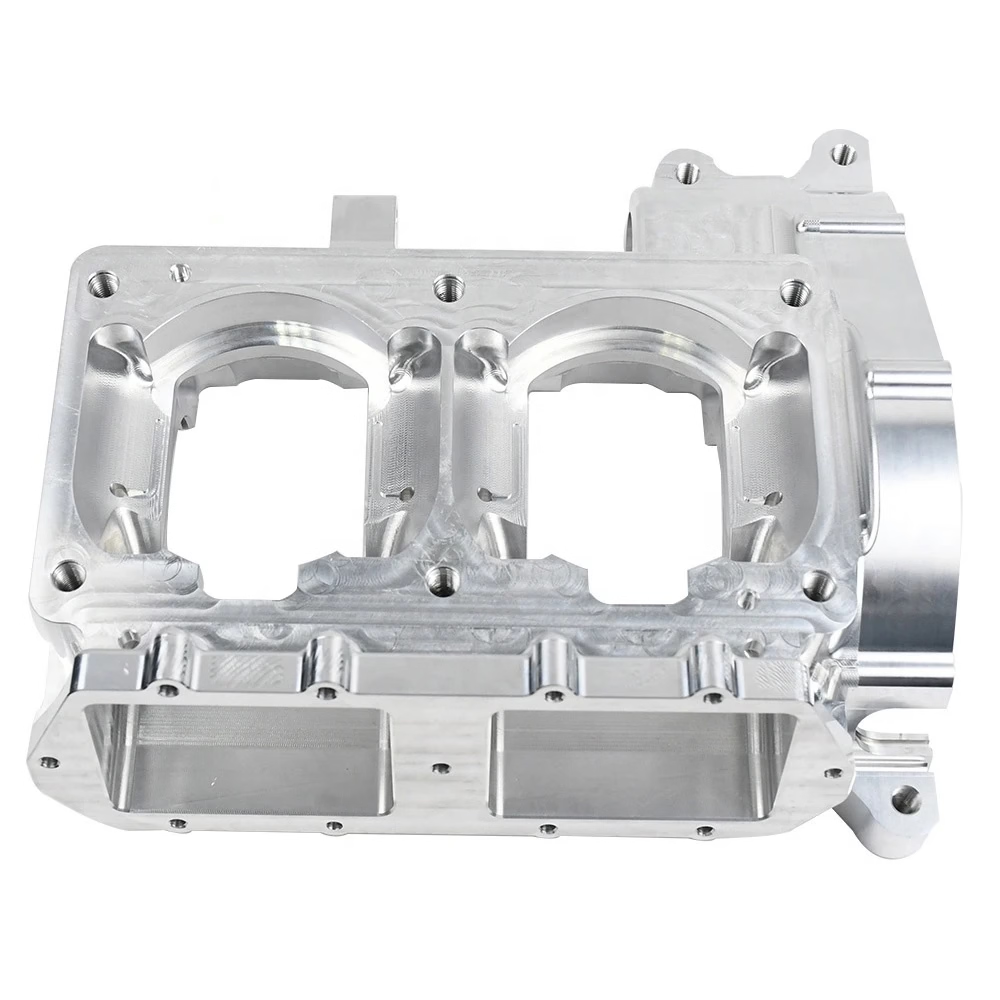
What a 3D Printed Truck Nut Actually Has to Do
A hanging accessory is a dynamic load case, not a decorative shell.
Why These Parts Fail on the Road
A 3D printed truck nut hangs from a trailer hook and moves with every bump. The mass sits at the end of a short arm, so road input turns into a repeated bending moment at the hook eye. That is a fatigue case, not a static one. A part that survives a bench pull test can still crack after two winters of highway use.
Plastic and rubber versions fail in predictable ways. UV breaks down the polymer chain, so the surface chalks and the part turns brittle. Cold weather drops impact strength further. Then the hook eye wears oval and the nut starts to swing loose on the pin.
Metal changes the failure mode. Instead of cracking, a metal truck nut wears at the eye and can be re-pinned. The trade-off is mass and cost, and that is where process choice matters.
- 1UV exposureUnstabilized polymers chalk and embrittle within one to two seasons.
- 2Cold impactBelow freezing, many plastics lose most of their impact strength.
- 3Eye wearSteel hook pins wear plastic eyes oval and cause rattle.
- 4VibrationConstant swinging loosens fasteners and opens clearance.
Where 3D Printing Fits and Where It Does Not
For a 3D printed truck nut, the honest answer is that polymer AM suits fit checks and short-term display parts. If the design has internal cavities, hollow lettering, or a lattice that would be expensive to mill, printing gets you a physical part fast. You can hold it, hang it, and check the proportions against the truck.
Metal additive is a different animal. Laser powder bed fusion builds a dense stainless or titanium part with a real eye and a real wall thickness. Shapes that cannot be reached by a cutter become possible: internal channels, sculpted surfaces, integrated brackets. Cost per part stays high, and surface finish out of the machine is rough, so secondary machining is usually required at the pin bore and any mounting face.
CNC machining wins once the geometry is reachable. A two-piece body with a turned pin boss and a milled profile is straightforward on a 5-axis center. You get ±0.005 mm on the bore, a controlled Ra 0.8–1.6 μm finish, and material properties that do not depend on build orientation.
When the shape is organic and the quantity is under a few hundred, metal AM makes sense. When the shape can be cut and the quantity is anything above a handful, subtractive is cheaper and stronger at the joint that matters.
- 1Polymer AMGood for form and fit; poor for load and UV life.
- 2Metal AMGood for organic shapes and internal channels; needs post-machining.
- 3CNC machiningBest for reachable geometry, tight bores, and repeat runs.
Process Comparison for a Truck Nut Body
Pick the process after you know the wall thickness and the eye load, not before.
| Process | Best geometry | Typical material | Watch out for |
|---|---|---|---|
| Polymer AM | Hollow or lattice shapes | ABS, PA, PC | UV and cold impact |
| Metal AM | Internal channels, organic ribs | 316L, Ti-6Al-4V | Rough as-built surface |
| 5-axis CNC | Turned boss, milled profile | 6061-T6, 316L | Tool reach in deep pockets |
| CNC + AM hybrid | Printed body, machined eye | 17-4PH, 316L | Two setups, longer lead time |
Materials That Survive Winter Salt
Stainless steel is the default for parts that see road salt. Grade 316 and 316L resist pitting far better than 304 in chloride exposure, and 17-4PH gives higher strength after aging if the eye is heavily loaded. For a lighter part, 6061-T6 aluminum with a hardcoat anodized layer holds up well, as long as the pin bore is not expected to take steel-on-aluminum wear.
Titanium, TC4 (Ti-6Al-4V), is the choice when mass matters and the budget allows it. It does not rust and keeps strength at low temperature. Machining it is slow, and the price reflects that.
For polymer versions, PA and PC blend toughness with printability. Add a UV-stabilized clear coat or a pigmented topcoat if the part will sit outside. Without that, expect color shift and surface chalking within a season.
The pin and hook side deserves the same attention. A stainless pin through a stainless eye can gall. A bronze bushing or a slightly different alloy on one side reduces that risk.
- 1316 / 316LBest all-round corrosion resistance for road salt.
- 217-4PHHigher strength, good corrosion, needs aging.
- 36061-T6Light and machinable; anodize for wear and color.
- 4TC4 titaniumLight, strong, corrosion-proof; slow to machine.
Designing the Eye and the Mount
The eye is the critical feature. Bore diameter should clear the hook pin by 0.2–0.4 mm for a swinging fit, or be a light press if you want no rattle. Wall thickness around the bore should be at least equal to the pin diameter for a metal part. Below that, the eye ovalizes.
Mounting brackets and integrated hooks should be designed around the actual trailer hook geometry, not a generic drawing. Measure the pin diameter, the hook opening, and the clearance to the bumper. A bracket that fits one truck may foul another.
If the design calls for laser marking, keep character height at 1.5 mm or more. Finer text fills in after anodizing or powder coating.
For anodized color, hardcoat gives the most wear resistance but limits color range. Standard anodizing gives more color options with less surface hardness. Powder coating is thicker and hides machining marks, but it changes the bore if you coat the eye. Mask the bore.
- 1Eye clearance0.2–0.4 mm for swing, or a light press for no rattle.
- 2Bore wallAt least the pin diameter for metal parts.
- 3MarkingMinimum 1.5 mm character height.
- 4CoatingMask the pin bore before powder coat or anodize.
Common Questions
Can a 3D printed truck nut hold up to daily highway use?
A polymer print will not last like metal. UV and cold impact break it down within a season or two, and the eye wears fast against a steel pin.
A metal AM or CNC machined part can handle daily use if the eye wall is thick enough and the surface is finished. Stainless or titanium is the safer call for year-round road exposure.
Which is stronger, metal 3D printing or CNC machining?
For the same alloy, a wrought CNC part is generally stronger and more consistent because there is no build orientation effect or internal porosity.
Metal AM can be strong too, especially after hot isostatic pressing, but it adds cost and time. Use AM when the shape demands it, not because it sounds newer.
How do you keep the part from rattling or swinging loose?
Control the bore clearance and the pin fit. A 0.2–0.4 mm clearance swings freely; a light press fit stays quiet.
Add a bronze bushing or a nylon washer at the eye if you want a quiet swing without a press fit.
What finish works best for an outdoor accessory?
Hardcoat anodizing on aluminum and passivated stainless both hold up well against salt and UV.
For color, standard anodizing or powder coating gives more options. Mask any bore you need to keep at tolerance.
Can you make a one-off custom design?
Yes. There is no minimum order quantity, so a single prototype and a 10,000+ part run are both possible.
Send a STEP file and we return a quotation with a free DFM analysis within 12 hours.
Send Your Design for a Process Recommendation
Upload a STEP file and we will tell you whether the part suits metal AM or CNC, with a quotation and free DFM analysis within 12 hours.
12-hour quote100% inspectionNo minimum order









