
2026 Volkswagen Golf R 350 Prototype: What the Test Mule Tells Engineers
Spy shots of the 2026 Volkswagen Golf R 350 prototype point to a higher-output EA888, a wider track and a bigger front cooling package. This page reads those changes the way a machining engineer would: which parts change, what they are made of, and where the tolerances land.
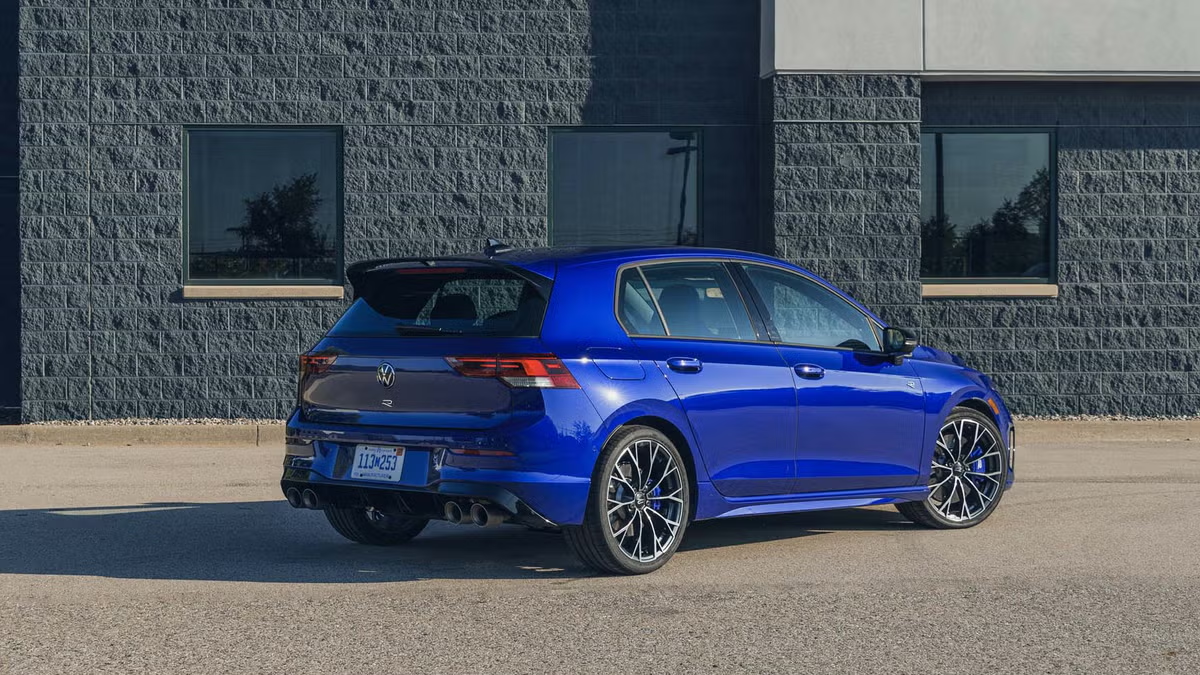
Reading a Camouflaged Golf R the Right Way
The vinyl hides the styling. It cannot hide the hardware underneath.
The 350 Badge and What It Means for the EA888
The number in the name is the whole story. Volkswagen's naming convention puts the output figure on the car, so the 2026 Volkswagen Golf R 350 prototype is read as roughly 350 PS, or about 345 hp in the US figure. The current car sits at 315 hp, so the gap is real but not enormous. That matters for parts, because a 30 to 35 hp step rarely needs a new block. It needs a better breathing path.
Expect an evolved EA888 2.0 L turbo four. The usual places to find that power are the turbocharger compressor and turbine housings, the fuel injection hardware, and the calibration. A larger compressor wheel moves more air at the same boost, but it also raises the load on the exhaust manifold and the turbo flange. Those are the parts that get redesigned first.
The transmission side usually follows. A strengthened seven-speed DSG is the likely pairing, with a manual option still discussed for some markets. Extra torque is what kills gearbox parts, not extra horsepower, so clutch packs and the mechatronic housing see the same treatment.
For anyone machining prototypes in this space, the useful signal is not the peak number. It is the shape of the change: tighter packaging around the turbo, higher thermal load on the manifold, and more clamping force needed at the flange joints.
- 1Output stepAbout 30 hp over the current 315 hp car.
- 2Engine familyEvolved EA888 2.0 L turbocharged four.
- 3Likely revisionsTurbo internals, injection, calibration.
- 4Weak point to watchTurbo flange and manifold under higher load.
Bigger Intakes, Wider Track, and Why Both Cost Machining Time
The front bumper on the mule carries larger openings than the production Mk8. That is not styling. A hotter engine needs more charge-air cooling, and a bigger intercooler needs more frontal area. The knock-on effect is packaging: charge pipes get rerouted, brackets move, and the crash structure has to stay intact.
At the side, the wheel arches look wider than stock. A wider track is one of the cheapest ways to add stability, but it pushes the wheel bearings, hubs and brake calipers outward. Hub faces and bearing housings are turned parts with tight runout requirements, and a few tenths of a millimeter of movement shows up as vibration at speed.
The rear spoiler is more pronounced, and the quad exhaust outlets are still there. Quad tips are a packaging problem as much as a sound decision. The rear valance has to route two extra pipes past the rear crash beam and the fuel tank shielding, which usually means a new set of brackets and heat shields.
None of these are exotic parts. They are brackets, housings, flanges and shields. The engineering work is in holding position and flatness across a family of them so the assembly does not fight itself.
Typical Underhood and Chassis Parts and How They Are Made
Ranges reflect common practice for automotive prototype and low-volume work at GreatLight.
| Part | Common material | Process | Typical tolerance |
|---|---|---|---|
| Turbo flange | 4130 or 4340 steel | 4-axis milling | ±0.005 mm on bolt pattern |
| Intake manifold | 6061-T6 aluminum | 3-axis + 5-axis milling | ±0.010 mm |
| Brake caliper bracket | 7075 aluminum | 5-axis machining | ±0.005 mm |
| Wheel hub | 4140 steel | Mill-turn | Runout under 0.01 mm |
| Heat shield | 5052 aluminum | Sheet metal + forming | ±0.2 mm |
| Exhaust hanger bracket | 304 stainless | Laser cut + brake form | ±0.15 mm |
Material Choice for Hot-Side and Cold-Side Parts
Turbo and exhaust hardware sees temperature swings that will destroy the wrong alloy. For flanges and manifold sections, 4130 and 4340 steel hold strength at temperature and machine cleanly. Stainless 304 and 316 work for heat shields and brackets where corrosion matters more than weight. Avoid 6061 in any location that regularly exceeds roughly 150 °C, because it loses a large share of its yield strength well before the exhaust gets hot.
Cold-side parts are a different decision. Intake manifolds, charge pipe brackets and sensor housings are usually 6061-T6 or 7075 for the weight. If the part also needs to shed heat, aluminum is the right call; if it needs to resist fatigue from constant vibration, steel is the safer one.
For brake and suspension hardware, 7075 aluminum is common on caliper brackets and 4140 on hubs and spindles. Both machine well on a mill-turn center because the part is mostly round with a few cross features.
The decision rule is simple. Match the alloy to the worst case, not the average case. A bracket that is only hot on track days still gets designed for track days.
Where 5-Axis Actually Saves Money on Automotive Prototypes
A machined intake manifold with curved runners is the classic case for simultaneous 5-axis. Reach into the runner from one setup, keep the port geometry consistent, and skip the fixture stack that a 3-axis machine would need. The accuracy gain is real, but the bigger win is setup time on a one-off part.
Brackets are the opposite. A flat exhaust hanger or heat shield does not need five axes. It needs a clean blank, a consistent bend line and a repeatable hole pattern. Putting that work on a 5-axis center is a waste of machine time.
Caliper brackets and hubs sit in the middle. They have round features and cross features, so a mill-turn center handles them in one or two setups. That keeps concentricity between the bore and the mounting face, which is exactly what the brake system cares about.
The practical test before quoting a part: count the setups needed to reach every feature. If the answer is more than two, 5-axis usually wins. If it is one, a 3-axis mill or a mill-turn center is cheaper and just as accurate.
From Spy Shot to Production Part: What Changes
A camouflaged test mule is built to answer questions, not to be sold. Parts on it are often machined from billet because casting tooling does not exist yet, or because engineers need to change wall thickness between test sessions. That is the stage where CNC work is fastest and cheapest per iteration.
Once the geometry stops moving, the process usually shifts. An intake manifold that was a 5-axis billet part becomes a casting with machined faces. A steel bracket that was milled becomes a stamping. The tolerances stay, the cost drops.
The transition is where a lot of projects lose time. The machined prototype and the production casting have to share datum structure, or the first production parts will not fit the fixtures that were validated on the prototype.
This is why prototype suppliers get pulled into production planning early. A datum scheme that works on a billet part often needs one extra machining operation once the part is cast. Finding that out at the prototype stage costs a phone call. Finding it out after tooling is cut costs weeks.
Common Questions
Is the Golf R 350 confirmed for production?
Volkswagen has not published a production confirmation for a 350 PS Golf R. The prototype has been photographed testing, and the name follows the company's output-based naming pattern. Treat the 350 figure as a strong indication, not a spec sheet.
Will the EA888 be replaced?
Nothing in the test mule suggests a new engine family. The changes point to an evolution of the existing 2.0 L turbo four, with revised turbo internals, injection hardware and calibration. That is the cheaper and faster route to a modest power increase.
What tolerance do automotive prototype parts usually need?
It depends on the joint. Bolt patterns and bearing bores typically land at ±0.005 mm. Brackets and covers often work at ±0.05 mm or looser. Over-tolerancing a heat shield adds cost with no benefit.
Can billet prototypes be used on a running test car?
Yes. Billet parts in 6061-T6, 7075 or 4140 are commonly run on development mules, including on track. The limits are thermal, not structural. Keep aluminum away from exhaust-proximate locations and the part will survive the test program.
How early should a machining supplier be involved?
Before the first billet part is quoted. Datum choices made on a prototype carry into production tooling. A supplier who knows the production intent can set up the prototype so the transition does not require a new fixture set.
Do you sign NDAs for automotive development work?
Yes. Uploads are handled as confidential, and an NDA is available on request before drawings are shared. Development geometry is the most sensitive data a program produces.
Send Us the Parts You Are Still Iterating On
Upload a drawing or a STEP file and we return a quotation with DFM notes within 12 hours. No minimum order quantity, from one prototype to a 10,000-part run.
12-hour quote±0.005 mmIATF 16949









