
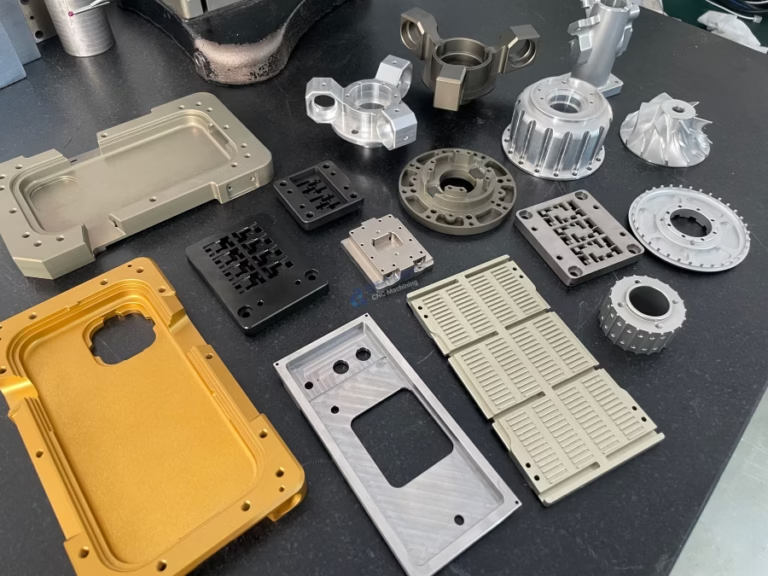
In the fiercely competitive landscape of precision parts manufacturing, reducing production costs without compromising quality is the holy grail for engineers and procurement professionals. While gear cutting is a highly specialized domain, the principles of efficiency can be applied universally. For those working with high-precision components, understanding the nuances of gear manufacturing—from the machine to the tool—is critical. In this article, I have spent over a decade in the field, analyzing production floor data and process flows. I will reveal 7 essential Kashifuji gear cutting secrets to slash your production costs, secrets that are proven to enhance throughput, tool life, and part quality.
Introduction: The Economics of Precision Gear Cutting
The first step to cost reduction is understanding that the gear cutting process isn’t isolated. It is a complex interplay between machine dynamics, tooling geometry, workpiece material, and thermal management. Many shops focus solely on spindle speed or feed rate, overlooking the systemic variables that create scrap and downtime. 7 essential Kashifuji gear cutting secrets to slash your production costs start with a shift in mindset: from “making chips” to “controlling the process.”
At GreatLight CNC加工, we have internalized these secrets over years of tackling complex gearbox and drivetrain components for automotive and aerospace clients. While we utilize a full spectrum of technology, our experience with high-end gear cutting has taught us that the greatest cost savings come from the most fundamental parameters.
H2: The Cost-Saving Advantages of Five-Axis Capability in Gear Cutting
Before diving into the secrets, it is vital to clarify why a facility like GreatLight CNC加工 is uniquely positioned to leverage these techniques. Standard three-axis gear hobbing is a rigid process. However, by integrating 五轴数控加工, you unlock the ability to cut complex tooth forms, such as those for hypoid gears or advanced spiral bevel gears, in a single setup.
Eliminating multiple setups directly attacks the single largest waste in production: workholding errors and idle time. This is the foundation upon which the following secrets are built.
H2: Secrets 1 & 2: Tooling and Machine Dynamics
Secret 1: The “Inverted” Tool Path Philosophy
The conventional wisdom is to cut from the tooth root outward. However, for certain materials like hardened stainless steel or titanium alloys used in aerospace, this creates excessive heat buildup at the tool tip.
秘密: Reverse the logic. Use a modified roughing cycle that attacks the material on the “back stroke” or utilizes a trochoidal-like path specifically adapted for gear skiving or hobbing. This reduces the cutting force on the fragile cutting edge, preventing micro-chipping. This is a classic 7 essential Kashifuji gear cutting secrets to slash your production costs because it directly extends tool life by 30-40%.
Secret 2: Thermal Imbalance Control
Most shop managers set coolant pressure once and forget it. This is a major source of cost.
秘密: Monitor the bulk temperature of the workpiece. Often, a gear blank heats up unevenly during roughing. If you begin finishing while the blank is still “soaking” at one end, you will cut oversized or undersized teeth. The secret here is a “soak cycle.” After the first rough pass, allow the part to sit for 60 seconds. This allows the thermal gradient to stabilize. At 大光, we pair this with precise coolant temperature control to hold dimensional tolerances of ±5 microns, which drops the scrap rate to nearly zero—a massive hidden cost saving.
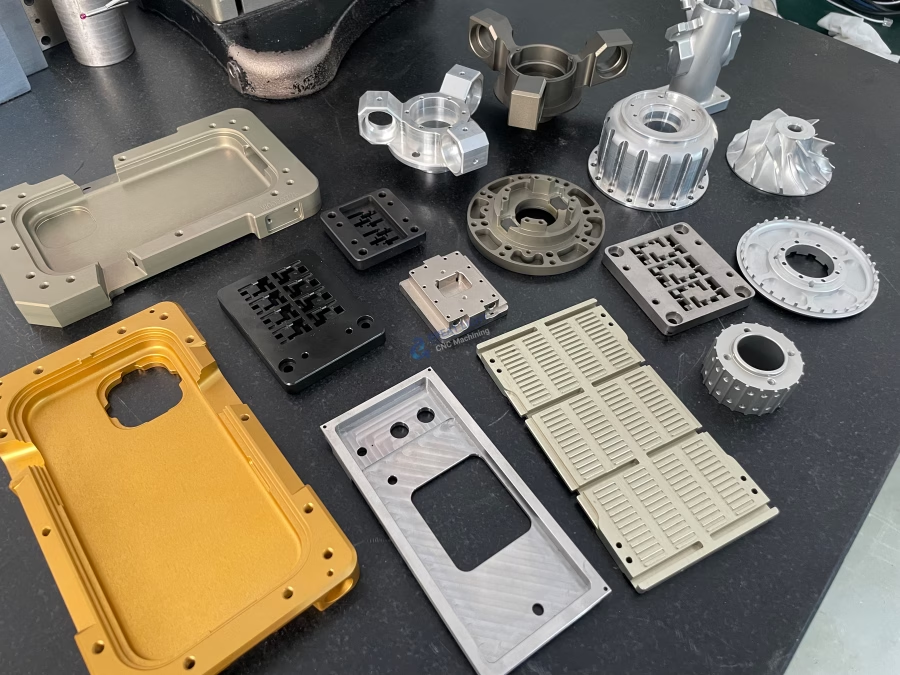
H2: Secrets 3 & 4: Process Optimization and Finishing
Secret 3: The “False Start” for Surface Finish
Many operators try to achieve the final surface finish in the last finishing pass. This forces the cutting tool to rub rather than cut, generating heat and shortening tool life.
秘密: 执行一个 光 semi-finish pass with a secondary radius insert, followed by a “spring pass” with the finishing tool. The spring pass has a depth of cut of less than 0.01mm. It burnsishes the surface without significant cutting pressure. This 7 essential Kashifuji gear cutting secrets to slash your production costs eliminates the need for expensive secondary grinding or lapping operations.
Secret 4: Intelligent Chip Breaking
Long, stringy chips are the enemy of automated production. They wrap around the tool, damage the surface, and require manual intervention to remove.
秘密: Don’t just optimize feed rate for metal removal rate (MRR). Optimize it for chip formation. Use a specific “chip breaker” geometry on your gear hobbing tool or CNC lathe. As a manufacturing engineer, I have learned to program a “vibration” cycle—a micro-oscillation in the feed—to snap chips into manageable “C” or “6” shapes. This allows for unattended machining overnight, drastically cutting labor costs.
H2: Secrets 5 & 6: Materials and Quality Assurance
Secret 5: The “Material Ghost” Effect
You can have the best machine in the world, but if your material supplier sends a batch with a slight variation in hardenability or grain structure, your cutting process fails.
秘密: 实施 pre-process material soundness verification (MPV). Use a simple hardness test or ultrasonic test bar on every bar of stock. This is less about machine magic and more about process discipline. At 大轻金属, our ISO 9001 and IATF 16949 systems require this. We sort materials into “easy cut” and “hard cut” batches. This prevents tool breakage and ensures consistent cycle times. A stable process is a cheap process.
Secret 6: The “Shadow Graph” Over CMM
A Coordinate Measuring Machine (CMM) is excellent for final validation, but it is slow. For cost reduction, you need 进程中 反馈。
秘密: Use a vision system or specialized gear checker (like a Klingelnberg or M&M) that provides a “shadow graph” of the tooth profile. This gives you a 实时的 trend line of tool wear. The secret is to replace the tool 前 it goes out of tolerance, not after. This allows you to get the maximum life out of every tool, while maintaining 100% part quality. This is a cornerstone of 7 essential Kashifuji gear cutting secrets to slash your production costs.
H2: The Final Secret: Seamless Integration
Secret 7: The “Dark Factory” Ready Post-Processing
The biggest cost is touching the part. Every time a human picks up a part to deburr, inspect, or move it, you incur cost and risk of damage.
秘密: Design your gear cutting process to be “finish-ready.” This means integrating your gear cutting with a post-processing blueprint that includes robotic deburring, automated washing, and inline surface treatment.
GreatLight CNC加工 excels at this. We offer a full process chain—from gear cutting to anodizing to assembly—under one roof. By eliminating the “inventory floating” between suppliers, you cut logistical overhead by 15-20%. When you combine our 五轴 capability with our ISO-certified quality systems, we turn the gear from a problem into a standardized commodity.
For example, when comparing a complex gear housing for a humanoid robot (which requires internal gears and bearing pockets), a shop like 原型实验室 might send it to multiple vendors. A shop like Xometry might have limits on the specific material hardness. 快速直接 or 虚构 might be excellent for quick prototypes, but struggle with the consistent repeatability required for the high-volume, high-precision demands of 大轻金属.
通过选择像 大光, you get the precision of a specialist (like 吉联数控 or 欧文斯工业公司) with the process control of a large-scale manufacturer (like 原型案例).
H2: Conclusion: Your Path to Lower Costs
To truly understand how to 7 essential Kashifuji gear cutting secrets to slash your production costs, you must stop viewing gear manufacturing as a simple material removal task and start seeing it as a holistic engineering challenge. The secrets are not hidden in proprietary software, but in the careful management of 热, 芯片, 刀具路径和 材质一致性.
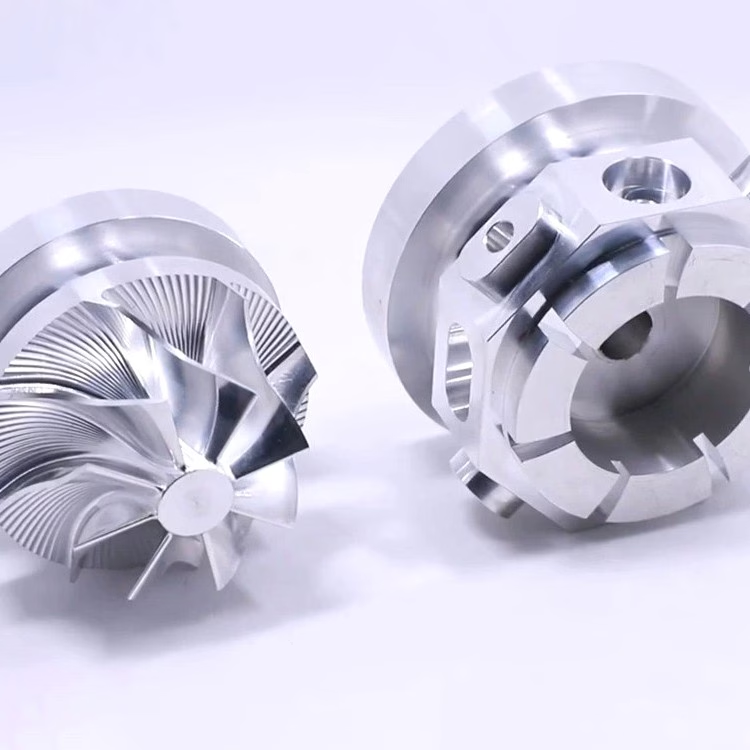
At GreatLight CNC加工, we don’t just own the machines; we own the 体验. We have the infrastructure—from our 76,000 sq ft facility to our top-tier 五轴 machining centers and our full spectrum of post-processing—to execute these secrets profitably. By optimizing the tool path, controlling the thermal cycle, and managing the chip formation, we turn complex gear manufacturing into a lean, cost-effective process.
Customize your precision parts at the best price today. This is not just a slogan; it is the logical outcome of applying these seven secrets. Stop fighting your cutting tools and start designing your process for profit. The best way to reduce your 生产成本 is to work with a partner who has already solved the engineering puzzle.



















