
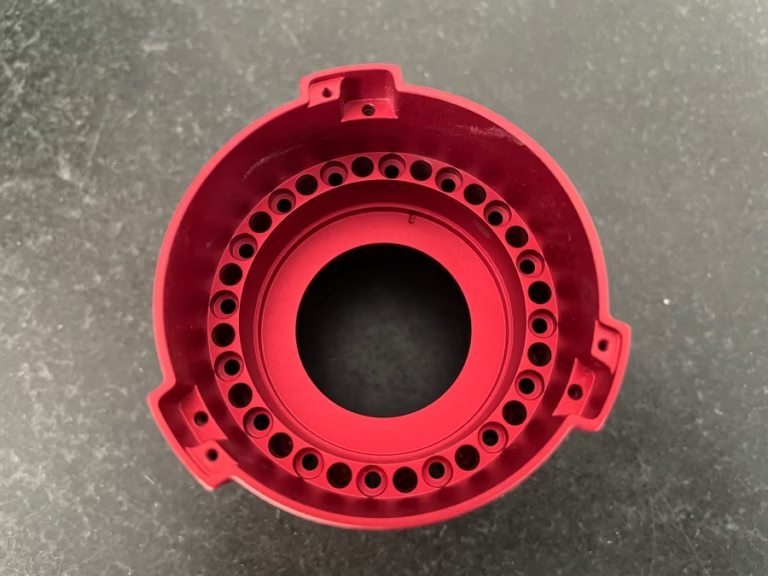
Investing in a 5-axis CNC mill is one of the most capital‑intensive decisions a precision machine shop can make. The topic “7 Critical Factors Before Buying a 5 Axis Mill for Sale (Or Risk Wasting $100K)” isn’t just a catchy headline – it reflects the reality that a poorly evaluated purchase can hemorrhage money, cripple production, and lock you into a maintenance nightmare. Whether you’re upgrading from 3‑axis capability or entering the world of simultaneous machining for the first time, the line between a game‑changing asset and a $100,000 mistake can be razor thin. Drawing on over a decade of hands‑on experience at GreatLight CNC Machining, where we operate a fleet of five‑axis, four‑axis, and three‑axis machining centers alongside integrated post‑processing and finishing, I’ll break down seven factors that must guide your decision. These insights come not only from our own production floor but from helping clients across automotive, medical, aerospace, and consumer electronics avoid the all‑too‑common pitfalls that turn a promised precision solution into a costly bottleneck.
Factor 1: Define Your True Dimensional and Geometric Requirements
Before so much as browsing listings for a mill, you need an uncompromisingly honest audit of the parts you actually make – and the ones you hope to make tomorrow. A 5‑axis machine can perform 3+2 positioning or full simultaneous contouring, but the difference has enormous implications for cost, programming, and fixturing.
提出以下问题:
What are your tightest true position tolerances? If you regularly hold ±0.0002″ (about ±0.005 mm) on critical features, the machine’s volumetric accuracy must be verified across the entire work envelope, not just in a single plane.
Do you require single‑setup machining of complex impellers, orthopedic implants, or aerospace structural brackets? Simultaneous five‑axis motion demands a high‑performance control system and dynamic tool centre point management (TCPM) to prevent tool path deviations.
Are your current parts simply 3‑axis components that could benefit from reduced setups? In that case, a 3+2 positioning machine may suffice, and the full simultaneous capability would be wasted capital.
Too many shops are seduced by “5‑axis” as a buzzword and end up paying for capability they never use, or worse, buy a machine that cannot actually meet the form‑and‑profile tolerances their customers demand. At GreatLight, we’ve seen the pain that stems from what we call the “precision black hole” – a gap between a supplier’s claimed accuracy and the actual, verifiable output in serial production. This same gap exists when you purchase a mill: a specification sheet that claims a positioning accuracy of ±0.0001″ may only hold true in a thermally stabilised lab, not during an eight‑hour shift in a shop with ambient temperature swings. Insist on a physical test cut of your representative geometry. Measure it on a calibrated CMM. That’s the only way to confirm the machine’s real‑world capability before signing the contract.
Factor 2: Kinematic Layout – Trunnion, Swivel‑Head, or Hybrid?
Five‑axis machines come in three predominant kinematic configurations, and each one dictates your work envelope, tool clearance, and fixturing flexibility.
Trunnion‑style (table‑table)
A rotary table (trunnion) tilts the workpiece while the spindle remains fixed in orientation. This design typically offers high rigidity for smaller to medium‑sized parts and excellent chip evacuation in the tilted orientation. However, the trunnion itself consumes part of the work area, and large, heavy parts can limit dynamic response.
Swivel‑head (head‑head)
The spindle head swivels to tilt the tool, while the workpiece sits on a fixed or rotary table. This layout allows machining of very large, heavy parts because the workpiece remains stationary, but tool stiffness can be slightly lower due to the moving head assembly. Programmers also need to be acutely aware of tool length offsets and collision zones, especially when machining deep cavities.
Hybrid (head‑table)
One axis of tilt is in the head, another in the table. This balances rigidity and accessibility. For example, a tilting spindle with a rotary table gives excellent reach for complex aerospace brackets.
When evaluating a mill, map your five largest part families onto each layout. At GreatLight, we run all configurations to match part geometry optimally: our Dema and Beijing Jingdiao high‑precision five‑axis machines cover both swivel‑head and trunnion designs, enabling us to handle everything from tiny medical instrument components to automotive engine housings. The same principle applies when buying: don’t assume one layout is universally superior. Let your part portfolio dictate the kinematics.
Factor 3: Controller and CAM Integration – The Brain of Your Operation
Even the most rigid cast iron frame is useless without a control system that can interpret advanced tool paths seamlessly. Most high‑end five‑axis mills use a Heidenhain, Siemens, Fanuc, or Fidia control. Each has its own philosophy and quirks.
Evaluate these aspects:
Look‑ahead and processing speed. Simultaneous five‑axis surfacing generates massive data streams. The control must process 200‑block look‑ahead or more to maintain constant feed rate and avoid dwell marks.
TCPM (Tool Centre Point Management) and RTCP. These functions allow the machine to maintain the exact tool‑to‑part contact point while the rotary axes move. Without robust RTCP, dynamic accuracy collapses as soon as the table tilts.
Collision avoidance (DCM/3D quick‑set). Advanced controls offer real‑time 3D simulation of the machine envelope. This prevents catastrophic crashes during prove‑out, especially when dealing with long‑reach tools or deep pockets.
CAM post‑processor compatibility. Your CAM system must have a proven, debugged post for the specific control and kinematics. A poorly tuned post can introduce gouges or force the operator to nervously override feeds. Before purchase, demand a test program and verify it runs without manual edits.
In our facility, the synergy between CAM programming (using hyper‑MILL, NX, and PowerMill) and machine control is non‑negotiable. When we assist clients who are evaluating their own equipment, we emphasise that the machine‑control‑CAM trinity is where “5‑axis capability” genuinely lives – or tragically dies.
Factor 4: The Hidden Expenses – Build a Total Cost of Ownership Model
A $200,000 price tag is just the beginning. The true five‑year cost of ownership can easily double that figure. Break it down into these often‑overlooked categories:
| 费用类别 | Typical Hidden Elements |
|---|---|
| Foundation & Installation | Isolated concrete pads, vibration damping, three‑phase power upgrades, air dryer capacity |
| 工装及工装夹具 | Self‑centring vises, zero‑point clamping systems, custom fixture kits, and a library of HSK/Capto tool holders |
| 耗材 | High‑performance carbide cutters, long‑reach shrink‑fit holders, precision measuring probes |
| 维护与校准 | Semi‑annual ball‑bar testing, laser interferometer calibration, spindle rebuilds, coolant quality management |
| 培训实施 | Both operator programming and maintenance certification – a steep learning curve wastes months |
| Software & Post‑Processor | Annual CAM maintenance, verification software (e.g., Vericut), and the non‑recurring expense of developing and proving your post |
| 能源与环境 | Climate control may be mandatory to hold sub‑micron tolerances; the HVAC load is substantial |
At GreatLight, we absorbed these costs over years and at scale. For a small to mid‑size shop, however, an incomplete TCO calculation can turn a supposedly profitable acquisition into a bottomless well of unexpected expense. One way to instantly reduce that burden is to reconsider whether you need to own the machine at all – a point we’ll explore in Factor 6.
Factor 5: Service, Calibration, and the Precision Guarantee
When your five‑axis machine goes down, every hour of downtime bleeds revenue and erodes customer trust. Investigate the machine builder’s local service infrastructure with as much rigour as you examine the spindle speed.
Demand answers to these:
What is the guaranteed response time for on‑site service? In many regions, it can exceed 72 hours. Can your production schedule survive a three‑day stoppage?
Are replacement parts stocked domestically, or do they ship from Europe/Japan? A simple encoder cable can become a two‑week wait.
What calibration protocol is offered? Look for ISO 230‑2 / 230‑6 verification. Ask if the supplier provides a laser calibration certificate at installation and how often they recommend re‑calibration.
Can you visit the factory to see the assembly process? Machines built on a thermally‑stabilised, granite‑bedded foundation line tend to hold accuracy longer than those assembled on standard steel weldments.
This is where the “precision black hole” that many buyers encounter originates: a machine may perform brilliantly for the first six months, then gradually drift as spindle bearings settle and ball‑screw preloads relax. Without rapid, expert recalibration, your process capability index drifts below acceptable levels. At GreatLight, our in‑house metrology lab and dedicated maintenance team perform weekly thermal compensation checks and monthly ball‑bar diagnostics across all 127 pieces of equipment. That culture of continuous verification, backed by rigorous ISO 9001, IATF 16949, and ISO 13485 quality systems, is what keeps us at ±0.001 mm when required. If you are buying your own mill, you must be prepared to replicate that discipline, or at least secure a service contract that does it for you.
Factor 6: The Outsourcing Alternative – When Not to Buy a 5‑Axis Mill
Before committing capital and signing a lease, ask a brutally honest question: “Do I need an in‑house machine, or do I just need the output of one?” This is the fork in the road that separates a wise investment from a stranded asset.
A growing number of hardware innovators, medical device startups, and even established tier‑one suppliers are turning to specialised precision manufacturing partners instead of building their own five‑axis capability. Why? Because a partner that already owns a fleet of advanced machines, holds international quality certifications, and maintains a full‑process chain (machining, die casting, sheet metal, 3D printing, post‑finishing) can deliver finished parts faster and more cost‑effectively than a newly purchased single mill ever could.
Consider the comparison of what a top‑tier partner offers versus going it alone:
Profile of a Full‑Service Manufacturing Partner (example: GreatLight Metal)
Machining equipment breadth: 5‑axis, 4‑axis, 3‑axis CNC, mill‑turn, Swiss‑type lathes, EDM; maximum workpiece size 4000 mm.
资质: ISO 9001, IATF 16949 (automotive), ISO 13485 (medical), ISO 27001 (data security).
Ancillary processes: In‑house vacuum casting, sheet metal, SLM/SLA/SLS 3D printing, and over a dozen surface finishing options.
质量验证: CMM, laser scanning, and real‑time process control across a 76,000 sq. ft. facility staffed by 150 specialists.
典型交付周期: Rapid prototypes in days, production quantities in weeks, without machine procurement delays.
Buying a Single 5‑Axis Mill In‑House
资本支出: $100,000–$500,000+ for the machine alone.
Time to capability: 3–6 months for delivery, installation, training, and post‑processor tuning.
Process coverage: Limited to subtractive metal/plastic removal; no inherent capability for additive, casting, or finishing without additional subcontractors.
Quality management burden: You must build and certify your own QMS, often from scratch.
Talent war: Competing for skilled 5‑axis programmers and operators in a tight labour market.
When you compare the two paths, the break‑even point for in‑house ownership often lies at extremely high part volumes or situations where government ITAR restrictions demand captive capability. For the vast majority of precision part needs – especially prototypes, pilot runs, and moderate‑volume production – an experienced partner is not just a stopgap; it’s a strategic advantage.
In the current manufacturing landscape, several service providers offer five‑axis capacity. These range from integrated manufacturers like GreatLight Metal (who provide one‑stop post‑processing and finishing under a single quality umbrella) to online aggregators such as Protolabs Network, Xometry, Fictiv, and JLCCNC, and niche high‑precision shops like Owens Industries or RCO Engineering. The key distinction is the depth of engineering support and the transparency of the quality system. When a partner like GreatLight already holds IATF 16949 certification, you don’t have to audit a separate machine shop; the entire production line—from incoming material verification to final surface treatment—is managed under a single, auditable framework. This eliminates the “precision black hole” of fragmented supply chains and allows you to focus on design iteration rather than supplier fire‑fighting.
If your volume is still growing or your part mix is heterogeneous, the smarter financial move may be to allocate that six‑figure budget toward 精密五轴数控加工服务 from an ISO‑certified partner, and delay machine ownership until the economics are unassailable.
Factor 7: Future‑Proofing and Resale – Protecting Your Investment
Assuming you’ve determined that buying a mill is indeed the right path, you must think about where your business will be in five years. A machine that perfectly suits today’s parts might become a limitation tomorrow.
Key considerations for future‑proofing:
Modularity and automation readiness. Does the machine support pallet changers, robotic loading, or gantry systems? As labour costs rise, unattended operation becomes a competitive necessity. Machines with native automation interfaces (e.g., EROWA or System 3R coupling) hold their value better.
Spindle options. A spindle with a wide RPM range (e.g., 12,000–30,000 RPM) and HSK‑A63 or Capto interface gives you flexibility to run tiny ball‑nose cutters for fine detail as well as large face mills for roughing. A single‑purpose spindle limits future job variance.
Software update trajectory. Does the control manufacturer provide long‑term support and upgrade paths? A legacy control that can’t handle the latest CAM features will effectively age the entire machine.
Resale market realities. Five‑axis mills depreciate steeply in the first three years, but a well‑maintained machine with full service records and calibration certificates from a respected brand (DMG Mori, Makino, Grob, Hermle) can recover 50–70% of its value after five years. Lesser‑known brands may suffer 80% depreciation or worse, because buyers rightly fear unproven long‑term accuracy.
One approach that many of our clients adopt is to start by routing the most complex jobs to a partner like GreatLight CNC加工 while they build the internal volume to justify a high‑end machine. This staged strategy preserves cash, reduces risk, and provides a benchmark for what “good” precision looks like – a benchmark you can then use when qualifying your own future equipment.
结语
“7 Critical Factors Before Buying a 5 Axis Mill for Sale (Or Risk Wasting $100K)” is a checklist that should be taped to the wall of every manufacturing executive considering this leap. From ruthlessly defining your geometric requirements and understanding kinematic trade‑offs, to calculating the true total cost, vetting service support, and seriously weighing the outsourcing alternative, each factor closes a door to a potential catastrophe. At GreatLight CNC Machining, we’ve spent over a decade navigating these exact decisions – both for our own 76,000‑square‑foot operation and for the hundreds of clients who rely on us to deliver precision components without the capital burden. Your decision doesn’t have to be a gamble. Arm yourself with the right information, run the numbers with brutal honesty, and you’ll join the ranks of manufacturers who turn 5‑axis capability into a genuine, lasting competitive edge.



















